Pricing Model Fit for High-Frequency Agentic Workloads
Databases built for human queries can't match the billing model that agentic workloads demand.
Database pricing was built around a human sitting at a keyboard, asking a question, and waiting for an answer. Agents don't work that way, and the mismatch between how pricing models expect traffic to behave and how agents actually generate it is the subject of this piece. A human query is bounded: one person, one question, one answer, done. An agent doing the same job runs continuously, in parallel, revising its own output along the way, and triggered by machine logic rather than a person deciding to look something up.
The write side of this shows the mismatch clearly. Agents update state, write records, and trigger downstream actions in real time, and standard lakehouse architectures were built for analytical reads, not the low-latency, high-frequency transactional writes agents generate now. Schema design strains under the same pressure. Agentic telemetry rarely holds to a fixed schema, so the database needs to ingest schemaless JSON while still answering SQL queries against nested fields. Brittle ETL pipelines built for tidy, predictable data simply fall behind.
Multi-agent orchestration turns this into a concurrency problem, not just a volume problem. Research on batched agentic workflows documents tens to hundreds of concurrent investigations running at once, with a single workflow fanning out into many retrieval-and-summarize calls across overlapping contexts, the same SQL query reused across different markets, product lines, or time windows. Reflection loops, where an agent re-queries to check its own prior answer, add another layer of short, repetitive queries stacking on top of the fan-out, adding load without proportional data movement.
Langfuse's observability platform offers a concrete look at what this forces in practice. The team moved to a single wide, mostly immutable table, denormalizing trace-level attributes onto every observation. That wasn't an aesthetic preference for a simpler schema. It was the only way to absorb a high-velocity, immutable stream of agent-generated events at the scale the platform needed to handle. When a production team redesigns its core schema around agent behavior, that's a signal the old assumptions about query shape no longer hold, and pricing built on those old assumptions won't hold either.
Billing Minimums as a Cost Multiplier for Short, Frequent Queries
Every managed database and data warehouse bills in increments. A query takes a fraction of a second to run, but the provider charges for a minimum unit of time or compute regardless, often rounding up to the nearest minute or billing floor. For a human-paced workload, that rounding is invisible. A business analyst runs a handful of queries a day, each billed at the minimum, and the gap between actual compute time and billed compute time is a rounding error buried in a much larger invoice.
Agents turn that rounding error into the whole story. A single agent running thousands of short, few-millisecond queries a day doesn't pay for thousands of milliseconds. It pays for thousands of billing minimums, because the floor, not the actual duration, sets the price. The query gets cheaper to run and more expensive to bill, and the gap grows in direct proportion to how often the agent asks.
Vector database pricing makes the mismatch impossible to miss. An October 2025 pricing shift raised minimums by 100 to 525 percent across major vector database providers, which is about as sharp a signal as pricing data gets that provisioned floors built for one traffic pattern don't survive contact with another. Providers that priced for occasional, human-triggered lookups found themselves billing for continuous, agent-driven probing, and the floors had to move to keep the economics from collapsing on their side of the ledger.
Established cloud data warehouses complicate this further with governance features layered on top of rigid billing minimums, and the workarounds teams build around those minimums (batching queries, pooling connections, scheduling instead of querying live) are themselves an admission that the billing unit doesn't fit the workload. When engineers start engineering around a pricing floor instead of around the actual problem they're solving, the floor has become the constraint, not the infrastructure underneath it.
S3-Routed Architectures and the Second Cost Multiplier
Object storage like S3 was built for a specific shape of access: large batches, sequential reads, infrequent requests. That shape fits analytics jobs that scan a day's worth of data once and produce a report. It does not fit an agent making thousands of small, random-access requests an hour, and the pricing structure underneath S3-routed architectures reflects that mismatch.
S3 charges per request, and at agent query frequency, those per-request charges can eclipse the cost of storing the data. This is a hidden cost multiplier that tracks how often agents query, not how much data sits at rest. A terabyte of quiet storage costs almost nothing extra to hold. The same terabyte, queried constantly by parallel agents, generates a request bill that scales with every probe, every reflection loop, every sub-agent checking its own work.
Practitioners running high-frequency OLAP workloads on object storage describe the result bluntly: per-request cost and rate-limit unpredictability make S3 prohibitive for large-scale systems, and bucket performance itself can degrade under load, raising error rates and latency across every system that depends on it. Routing high-frequency, random-access reads through infrastructure designed for batch retrieval is a structural property, not a tuning problem to solve with better indexes.
Teams try to batch their way around this, but batching assumes writes can wait, and agents frequently need atomic writes that can't be deferred. S3 rate limits still have to be handled explicitly even with batching in place; the coordination work needed to manage those limits undercuts the low-latency guarantees agents depend on to function well. The fix for one bottleneck reintroduces another, because the underlying architecture was never built for this access pattern to begin with.
Managed database pricing compounds both problems rather than absorbing them
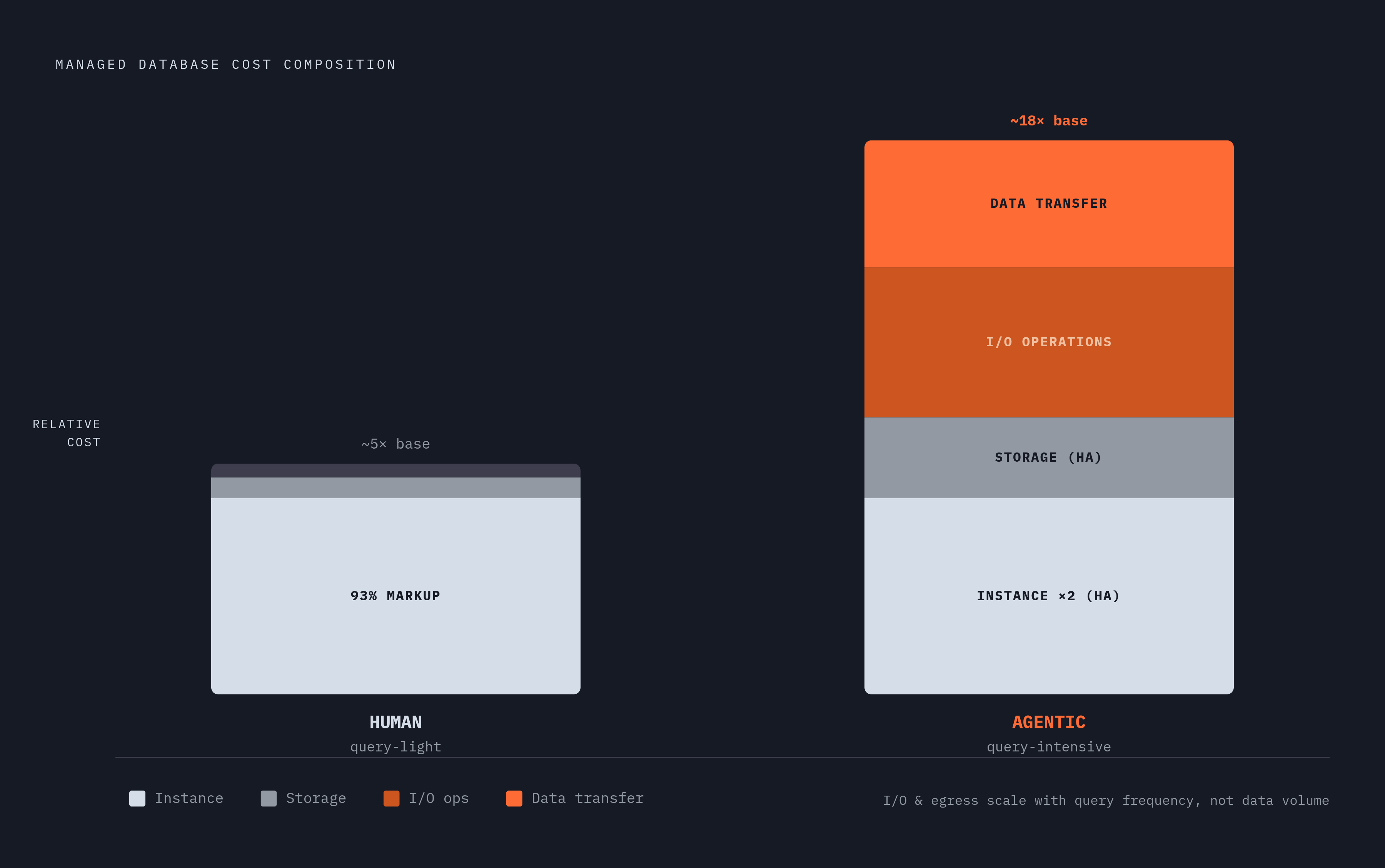
Managed database pricing has four components: instance cost, storage cost, I/O operations, and data transfer. Agentic workloads hit three of the four components that most engineers barely look at. Procurement decisions get made almost entirely on instance pricing, the number quoted up front, the line item that's easy to compare across providers. That number is the smallest part of the real story for a workload that queries constantly.
Selfhost.dev's managed PostgreSQL comparison finds AWS RDS runs a 93 percent markup over raw compute, and high-availability configurations double compute costs while pushing storage into higher pricing tiers. That markup alone surprises engineers who sized their budget off the instance sticker price. Agentic query frequency layers on top of that markup, compounding the surprise.
Agents drive I/O operations and data transfer at a rate human workloads never approach. Every short query that trips a billing minimum also triggers a storage read, and in S3-routed architectures, that same query adds an egress charge on top. None of these costs appear in the instance price. All of them scale with how often the agent asks, not with how much data the agent actually needs.
The three components compound rather than sitting side by side. A workload that looks affordable when measured against instance pricing turns expensive once I/O operations and egress get measured at the frequency agents actually generate. Traditional cloud data warehouses handle batch business intelligence well, where latency measured in minutes or seconds is fine, but they weren't built for sub-second, high-concurrency access. Many teams bolt on a purpose-built real-time OLAP engine as a speed layer, adding a new line to the cost stack instead of replacing the old one. The bill grows wider, not simpler.
The right pricing unit for agentic workloads
Agents consume resources continuously and in parallel. Pricing that charges per query or per scan treats every one of those parallel, continuous operations as a discrete, billable event, and that mismatch between how the resource is used and how it's billed is where the real cost problem lives. The unit has to match the consumption pattern, and for agents, that unit is compute capacity, not query count.
Per-query pricing acts as a tax on curiosity. Every self-critique loop, every iterative refinement, and every parallel sub-agent probing a slightly different angle adds a line item to the bill, whether or not any of it produces something useful. That creates a perverse incentive: teams start constraining agent behavior to control cost, narrowing the exploration that makes agents valuable in the first place, instead of letting the agent probe freely toward a better answer. Research on batched agentic workflows shows the efficiency gains available from shared computation, repeated prompts and overlapping contexts reused across calls, are exactly where the architecture can save the most. Charge per query, and those gains get erased at the billing layer even when the infrastructure captured them cleanly underneath.
Compute-capacity pricing decouples the cost of a question from the number of questions asked. A fleet of agents running thousands of queries against a provisioned compute pool pays the same as a single agent running one, as long as both stay inside that pool's capacity. That aligns the bill with the architecture: agents exhaust compute, not a query budget, and pricing should track the thing actually being consumed.
An architectural prerequisite produces this: without it, none of the rest works. Hot data has to stay in memory and off S3 for the query path, through a cache-mesh or NVMe-tier approach, so that per-request storage costs stop accumulating alongside compute costs. Capacity pricing isn't just a different label on the invoice. It only holds up because the infrastructure underneath it was built to serve reads without re-triggering the per-request charges that make S3-routed architectures expensive at agent frequency. Without that structural piece, compute-capacity pricing is just a name for the same mismatch under a different billing formula.
The accountability requirement that compute-capacity pricing must satisfy to be viable for enterprise agents
Removing per-query cost friction raises an obvious question: what stops an agent with no per-query cost from running unchecked? Pricing that no longer punishes frequency has to be paired with something that keeps frequency visible, because autonomous database access without a full record of what was accessed and when is a governance liability no enterprise can accept, no matter how clean the economics look.
The risk here isn't hypothetical. Researchers have catalogued security and privacy risks specific to agentic systems, including malicious code execution, remote access and control, credential theft, and gaps in authentication, authorization, and auditability. The threat surface widens once agents can query a database at machine frequency without a human reviewing each call, so you have to ask how to keep that surface closed without reintroducing the cost friction the pricing model was built to remove.
The answer sits in how access itself is structured. Isolated, read-only compute for agents operating over shared data, every query logged in full, and sandboxed branches that let agents run experiments against real data without ever touching production: that combination gives agents room to explore while keeping a complete record of what they touched. Sandboxed branching matters specifically because it lets an agent run iterative, exploratory, even destructive-seeming operations, like schema exploration, backfill probes, speculative aggregations, without the production risk that would otherwise justify charging a toll on every single query just to slow the agent down.
Full query logging closes the loop. Removing per-query billing doesn't mean you remove per-query visibility, because the audit trail here is architectural rather than economic. The record of what an agent did lives in the logging infrastructure, not in the invoice. The invoice is free to track compute capacity while the audit system handles accountability on its own terms. That separation is what makes compute-capacity pricing viable for an enterprise agent deployment rather than just an attractive number on a vendor's pricing page.
Evaluating whether your current pricing model fits your agentic workload
Start with query duration distributions and concurrency profiles, not average load or storage costs, because billing minimums and S3 egress charges only become visible at the tails of that distribution, not in the averages most teams check first. A workload that looks fine on paper, modest average query time, reasonable total storage, can still be absorbing a punishing bill if a meaningful share of its queries are short enough to hit a billing floor on every single call.
Pull the actual shape of agent traffic before making any pricing decision: how many queries run in parallel at peak, how short the median query actually is, and how often reflection or self-critique loops send the same question back through the system a second or third time. Each of those numbers maps directly onto one of the mismatches already covered, billing minimums, S3 request charges, and the hidden I/O and egress components in managed database bills, so a traffic profile that shows many short, frequent, parallel queries is a profile already primed to run into all three.
From there, the evaluation has to move past billing into architecture: does every read route through object storage, or does a cache tier absorb the high-frequency path before it ever reaches S3? If every read routes through object storage, agent query volume scales up no matter how the billing is structured; if a cache tier absorbs the high-frequency path first, volume scales down as infrastructure improves. A team that finds its hot data path running straight through S3 on every agent query has found the actual constraint, and no pricing negotiation fixes an architecture built for a different traffic pattern than the one now running through it.
The honest version of this evaluation doesn't end with a verdict so much as a map: where the current model was built for human-paced traffic, where agent behavior has already outgrown it, and where the fix has to happen in the architecture before the bill forces the question.