What Happens to Cache and Latency When an Agent Fires 50 Queries at Once
Concurrent agent queries overwhelm columnar databases through CPU cache thrashing.
Fifty simultaneous queries from an AI agent do more damage to a columnar database than fifty queries spread out over a minute, even though the total work looks identical on paper. How columnar engines were built and how agents actually behave create a gap that raises CPU cache contention first, then latency, then cost.
Why agent fan-out breaks columnar engine assumptions
Columnar analytical engines and AI agents run on incompatible assumptions about how queries show up, and a burst of simultaneous agent queries exposes that mismatch right down at the hardware level. Columnar engines were built to scan columns sequentially, reading through long stretches of similar data with high spatial locality. That design pays off when queries arrive one after another, paced out, so each one finishes before the next begins. An AI agent does not work that way. Aerospike's 2026 guide to ML and AI databases describes how a single user prompt in an agentic system can trigger hundreds of internal operations, spread across retrieval steps, multiple model calls, tool invocations, and follow-up queries. A 2026 infrastructure analysis on DEV.to frames the shift as a full inversion of the original design target: traditional databases were built for humans who run a handful of queries across an entire session, seconds apart, while an agent runs many queries in a tight loop to answer one single request. This is a different pattern altogether, one that hits a concurrency ceiling columnar systems were never built to clear, because these systems typically support tens to hundreds of analytical queries per node, far below the thousands of point queries a row-oriented system can handle per node. A node that ran perfectly under paced human queries can saturate because concurrent column scans cause CPU cache eviction, producing worse outcomes than the same number of queries run sequentially. None of this is a tuning failure. It is what happens when a design built around sequence meets a workload built around burst.
Cache thrashing at the CPU level under concurrent column scans
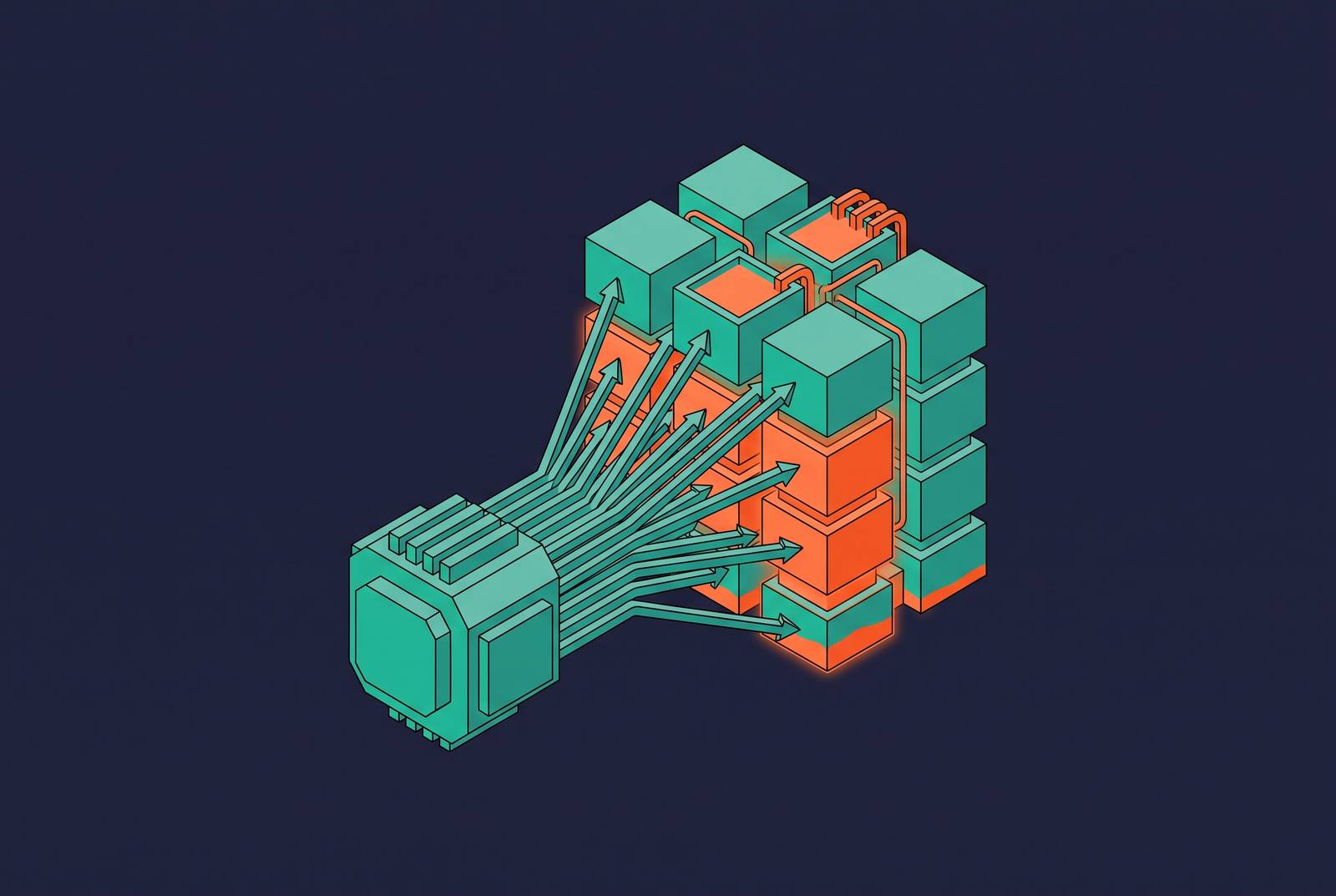
The mismatch above plays out concretely inside the CPU, in the form of cache eviction. Fifty concurrent agent queries scan column ranges that overlap but don't quite match, so they end up competing for the same physical cache space, and they keep knocking each other's data out before it can be reused. A performance feature turns into a liability under exactly these conditions.
Fetching data from L1 cache instead of DRAM is dramatically faster; if the engine has to reach all the way to SSD, the penalty grows far larger still. Vectorized query processing, the technique columnar engines rely on for speed, depends on reading a column in order so each cache line gets fully used before it's evicted. Fan-out breaks that assumption, because every concurrent query is pulling on the same cache lines from a different offset. Vectorized processing doesn't stop working under this pressure, but its advantage shrinks as concurrency climbs, since the engine spends more and more of its cycles re-fetching data a neighboring query just knocked out. Picture fifty readers sharing one bookshelf that only holds a few books at a time: each one keeps pulling out what the last reader just put back.
How fan-out converts rare slow events into user-visible latency
This is where the cache mechanism turns into something a user actually feels. A database that responds slowly only a tiny fraction of the time looks safe on a dashboard, but fan-out turns that rare event into something close to routine.
Aerospike's 2026 guide walks through the math: if a database is slow only a tiny fraction of the time, spreading that risk across many fan-out calls pushes the odds that any single user request hits a slow one up toward roughly 1%, and the deeper the fan-out goes, the more often the system lands in that long tail. Teams that watch p99 and call it a day are still under-targeting, because for production AI, the user's actual experience rides on p99.9 and p99.99, not p99. Fan-out latency is set by the slowest branch of the whole operation, not by the sum of all the branches, and that detail sounds like good news until you notice that "slowest branch" is a random draw from the tail of the distribution. Add to that the sources of variance that stack across hops, cache hit rate, garbage collection pauses, vacuum or compaction cycles, hot-shard imbalance, and the picture gets worse the more hops an agent's workflow involves.
The DEV.to analysis puts the human consequence in plain terms: when an agent runs many queries in a tight loop and each one takes a meaningful slice of time, the waiting adds up, and in a conversational interface, a few seconds of silence reads as a broken product. A system can have excellent median latency and still fail the moment a real user is staring at a loading indicator. Why does a well-tuned system still fail here? Because tuning for the average case says nothing about what happens when fifty draws from the tail happen inside the same half-second window.
The specific failure modes that concurrent agent load triggers in columnar systems
Cache thrashing is the opening move in a longer chain. It opens the door to a chain of secondary failures, each one adding its own latency floor and each one making the next more likely.
Compaction storms come first for write-heavy workloads: concurrent write traffic triggers simultaneous compactions, and the resulting CPU and I/O spikes slow down every query on that node, including reads that have nothing to do with the writes causing the trouble, a risk identified in 2026 operational literature under concurrent agent load. Skewed partitioning follows close behind: fan-out queries route unevenly, overloading one node while others sit idle, and because aggregate cluster throughput still looks fine, the problem hides from anyone watching only the top-line numbers. If reads route through object storage, provider-side latency variability adds a non-deterministic floor at p95 and above, a structural property of the architecture rather than a bug you can patch. High-cardinality aggregations add their own risk: when several agents issue aggregations over high-cardinality columns at the same time, memory pressure can push the system into an out-of-memory failure instead of a graceful slowdown.
There's also a failure mode that has nothing to do with speed: when agents both read and write, updating state, saving intermediate reasoning as they go, a single failed cache invalidation means every subsequent request serves stale data until a TTL expires, and that window can run for hours. One production AI-powered ad recommendation system hit exactly this problem: asset staleness of 2 seconds became a documented issue in a context where 2 seconds was long enough for user intent to shift and inventory to sell out from under the recommendation. Fan-out raises the odds of this kind of failure happening, and it's a correctness problem, not a latency problem. Each of these failures feeds the next: a compaction storm reduces cache effectiveness, which pushes read latency up, which widens the window during which an invalidation failure can quietly accumulate stale data. One might argue that any one of these failure modes, on its own, is manageable. Stacked together under concurrent agent load, they compound the same way the latency numbers do.
Structural differences between agentic and human query shapes
Whether this is really just "more queries, faster" or something else entirely, the research says something else. The shape an agent's queries take has a different topology than a human's, and that topology breaks cache prefetching and partition design assumptions that were tuned for human behavior.
Researchers at Columbia University's DAPLab, building a benchmark called BranchBench, catalogued the shapes these branching patterns actually take: shallow fan-outs that compare many independent alternatives side by side, deep speculative chains that follow one line of reasoning several steps deep, and MCTS-style agents that keep wide trees of possibilities alive, pruning weak branches and expanding promising ones, with each node in that tree potentially tied to its own database-backed state. Each of those shapes stresses a database differently: a shallow fan-out hits many partitions at once for a short burst, while a deep speculative chain holds state open across a long sequence of dependent calls. Neither looks like the steady, paced sequence of queries a human analyst produces.
Harvard's work on agentic context cracking adds a number that shows how fast this multiplies: on the FanOutQA benchmark, reasoning over an ideally pre-structured data store runs 28 times cheaper than reasoning over unstructured documents, and that gap widens to orders of magnitude as the questions fan out across more documents. The fan-out multiplier isn't linear. It grows with the shape of the question as well as its volume.
In orchestration frameworks like LangGraph, a coordinator dispatches many specialized subtasks at once and then waits to aggregate the results, making a 50-query burst a normal unit of work rather than an edge case to plan around. Production-pattern research covering enterprise customers across finance, SaaS, and healthcare, run on PromptQL, confirmed that real data-agent workloads run far more complex than simple text-to-SQL translation. At the extreme, some benchmark queries span up to six databases across three separate systems, and stock-market queries have to navigate an enormous number of tables to answer a single question. That's not a workload columnar cache design can anticipate with prefetching tuned for human sequences.
The compounding tax of object-storage-routed architectures under agent fan-out
Architectures that route reads through object storage don't just add a bit of latency under fan-out. They multiply the cost of every cache miss, and they make the variance floor something no amount of tuning removes.
Query startup variability on S3-backed engines makes sub-second latency targets hard to guarantee in practice, and the trouble isn't that latency runs high on average. It runs high unpredictably, which is precisely the property that compounds once fan-out starts stacking draws from that same unpredictable distribution. Pricing adds a second dimension to the same problem. Per-scan pricing models, including Amazon Athena and BigQuery's on-demand pricing, charge per tebibyte scanned, and under a high-fan-out agent workload that becomes a direct cost multiplier, since each query pays its own scan cost even when it overlaps heavily with queries running right next to it. Snowflake's 60-second minimum billing window on every warehouse resume adds a specific penalty for exactly the kind of bursty, spike-and-subside traffic an agent produces. The burst pattern that fan-out creates is the pattern that maximizes that overhead, not an occasional edge case.
Even the storage tier built to handle this kind of load carries an explicit tradeoff. S3 Express One Zone, built for ML and analytics I/O, delivers consistent single-digit millisecond latency at high request rates, but costs substantially more than S3 Standard per GB per month. The tradeoff between predictable latency and cost is priced directly into the storage tier itself.
What architectures absorb fan-out more gracefully
Some architectures handle fifty simultaneous agent queries without falling into this spiral, and they share a specific set of properties: hot data kept in memory, compute isolated per workload, and read paths that skip object storage entirely under normal load.
The core shift is what happens on a cache miss. In-memory architectures turn a cache miss into a trip to local NVMe instead of a round trip to S3, which replaces a variable network hop with a predictable local one, and that predictability is what makes a p99.9 latency target something engineers can actually design for rather than something they hope for. Two production examples show what this looks like at real scale. Wayfair's predictive AI recommendation system, running on Aerospike, handles 1 million transactions per second at sub-millisecond p99.9 latency across seven nodes. Criteo runs a very large number of ad matches per day at sub-millisecond internal read latency, after consolidating down from a much larger server footprint to a fraction of its original size. Both cases show in-memory architectures absorbing fan-out at a scale where a columnar engine would likely be mid-compaction.
Practitioner guidance points to a sub-50-millisecond target for feature retrieval, the budget that leaves room for everything else in the inference pipeline to run before the user notices a delay. An architecture that reliably stays under that budget even under fan-out is one where the database stops being the bottleneck. A cache-mesh approach, keeping hot data in memory, never routing queries through S3 under load, and separating compute from storage at the layer underneath the cache, removes the two biggest sources of variance discussed so far: object-store latency spikes and cold fetches triggered by cache eviction. Isolated, read-only compute assigned per agent workload stops one agent's fan-out from evicting another agent's working set, which is the exact mechanism described earlier in the cache-thrashing section, now addressed at the architecture level instead of left to chance.
MCP as the instrumentation and control layer for agent fan-out
Every failure mode traced through this piece, cache thrashing, compaction storms, skewed partitioning, stale invalidations, has one thing in common: it happens after the agent has already issued its queries.
That position matters because it's the only point in the chain where someone can count how many calls a single user prompt actually triggers, attach rate limits to that count, and log which agent, which session, and which downstream system each call touched. None of the cache physics described earlier change based on what sits in front of the database, but the blast radius of a bad fan-out event does. A rate limit enforced at that layer caps how many of those fifty queries ever reach the columnar engine at once, which caps how much cache a single burst can evict and how many compaction storms a single agent can trigger. Logging at that layer also closes a gap that matters for correctness, not just performance: when cache invalidation fails silently and a request serves stale data, someone can trace that a particular agent call wrote the state that later went stale, and when. That traceability doesn't fix the physics of cache eviction or the probability math behind p99.9 latency. It gives the people operating these systems a place to watch for the warning signs before fifty queries become the normal shape of every request.
Sources
- Agentic Context Cracking: Token-Efficient Data Reasoning Agents via Adaptive Structuring of Unstructured Data
- The Database Bottleneck You Never Saw Coming: Why 50ms Will Make or Break Your AI Agent in 2026 - DEV Community
- Determining the Best Machine Learning and AI Databases (2026)
- Branchable Databases Aren't Ready for Agentic Workloads