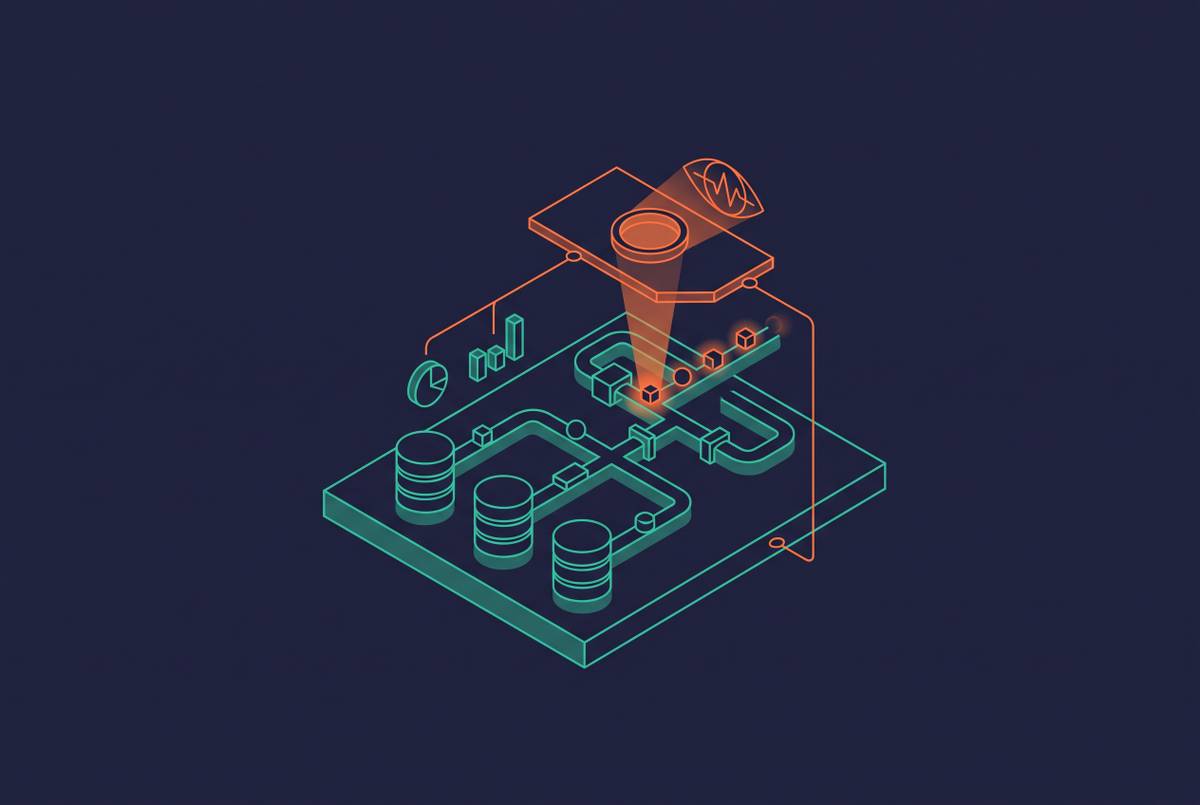
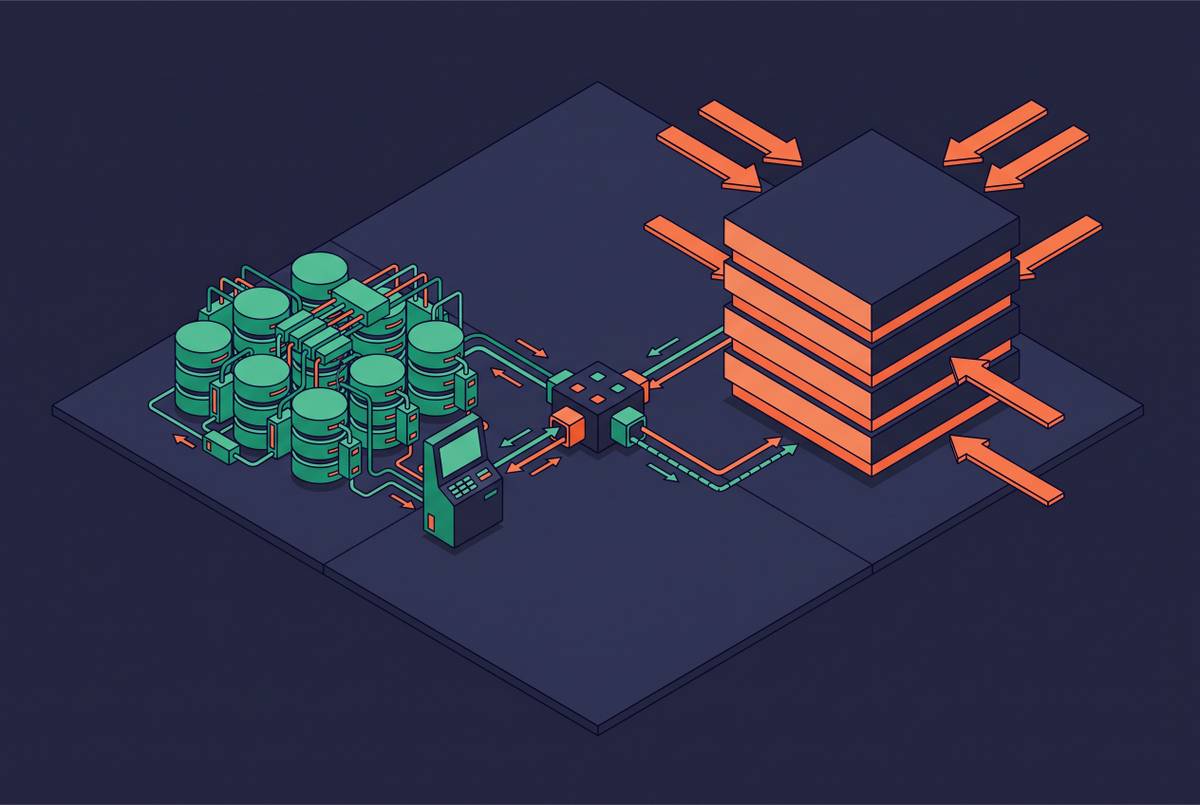
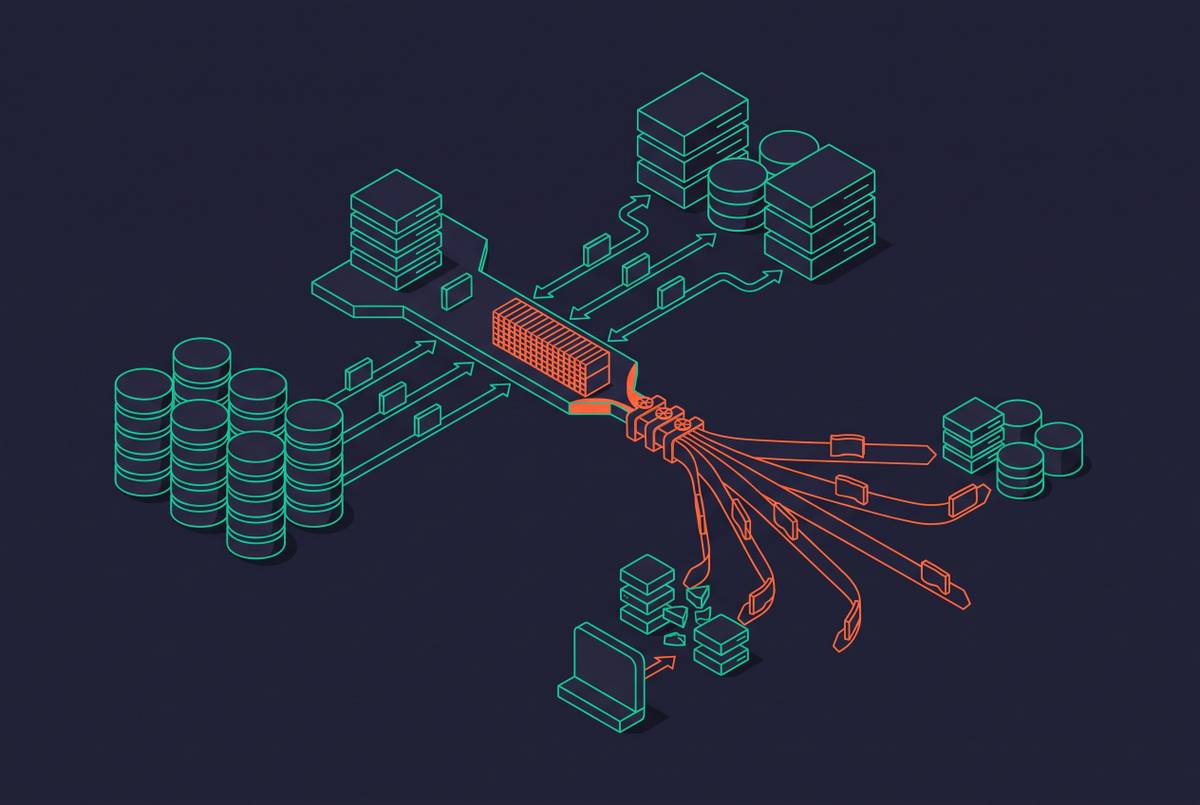
Traffic Shadowing for Validating Real-Time Analytical Pipeline Changes
Shadow traffic lets you validate pipeline changes against real production data with zero user risk.
Staging runs on smaller caches, cleaner databases, and simpler network paths, so it never looks like production. That gap hides the exact conditions that cause failures: resource contention, data skew, cold starts, and the downstream latency that only shows up once real load hits the system. Synthetic tests follow scripts written in advance, but production traffic is uneven and bursty, and it's full of malformed requests and long-tail payloads that no test suite was built to generate. A system can pass every staging test and still buckle the first week it meets real usage, because variance is the thing staging was never designed to produce.
The failure modes that matter most, tail latency spikes, retry amplification, thread exhaustion, autoscaling delays, are systemic. A synthetic test can confirm that a query returns the right answer. It cannot confirm that the system holds up when ten thousand of those queries land in the same second alongside everything else production is doing.
Analytical pipelines make this worse. Schema drift, a source system renaming a column, changing a data type, adding or removing a field without telling anyone, is one of the most common causes of silent pipeline failure, and staging rarely catches it because staging data doesn't drift the way production data does. For pipelines feeding fraud detection or dynamic pricing, even a short window of bad data moving undetected through a changed pipeline has real downstream cost. Synthetic benchmarks go stale when the eval dataset hasn't been updated recently; it no longer represents what queries are actually arriving, and a pipeline can pass its benchmark while validating against traffic that stopped existing months ago.
What shadow traffic is
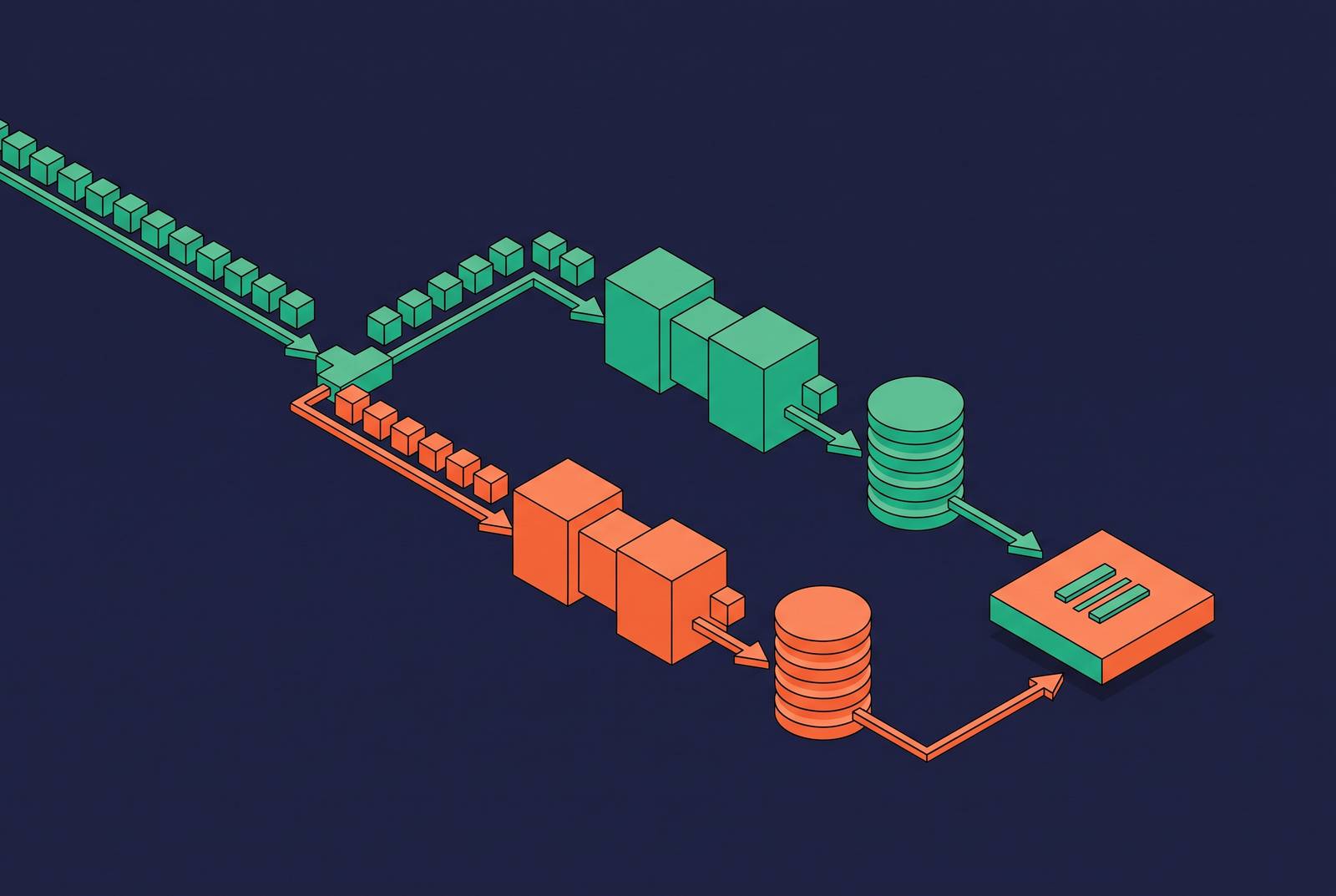
Shadow traffic is a production-mirroring technique. Live requests get duplicated and sent to a candidate system, that system's responses are discarded, and the production response is the only one users ever see. The payoff is production-grade signal with no user-facing risk.
The mechanism is straightforward. Only the request gets shadowed, not the response path. You still collect every normal metric for the shadow service, so you can measure it the same way you'd measure anything running live. The production path always wins: it gets served first, and the shadow copy runs asynchronously after the real response has already gone out, so users feel no latency cost. Bugs in the shadow service stay contained there, as long as the shadow environment is properly isolated from production databases and downstream systems.
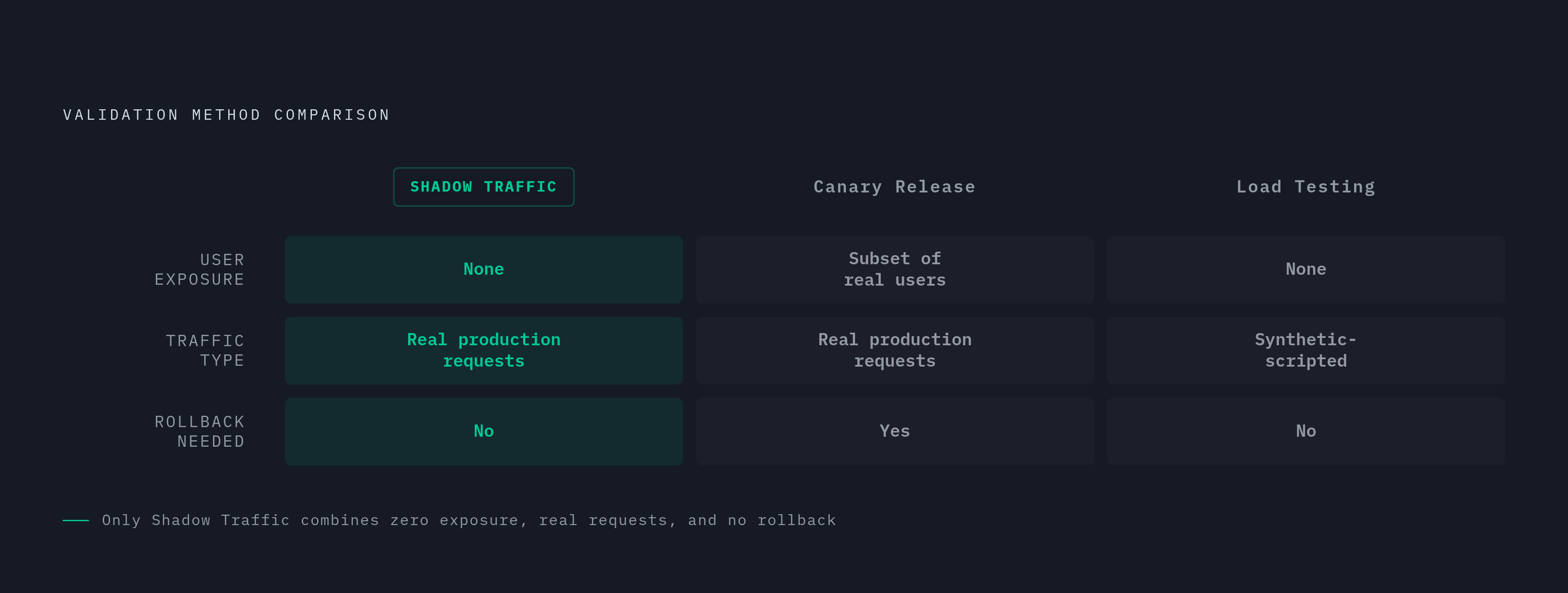
How does this compare to the tools engineers already reach for? Canary deployments expose a real slice of users to the new version, and if something goes wrong, someone has to roll it back. Shadow traffic exposes zero users, so it needs no rollback, because nothing it does ever reaches a user. Load testing relies on synthetic or scripted traffic built to look like production. Shadow traffic uses actual user payloads and actual data shapes, which is a higher-fidelity signal because it's not a guess at what production looks like, it is production. Feature flags change what real users experience when a flag is on. Shadow traffic runs an entirely parallel path that users never touch, flag or no flag.
| Method | User exposure | Traffic type | Rollback needed | |---|---|---|---| | Shadow traffic | None | Real production requests | No | | Canary release | Subset of real users | Real production requests | Yes | | Load testing | None | Synthetic/scripted | No |
The three-layer architecture that makes shadow traffic work in practice
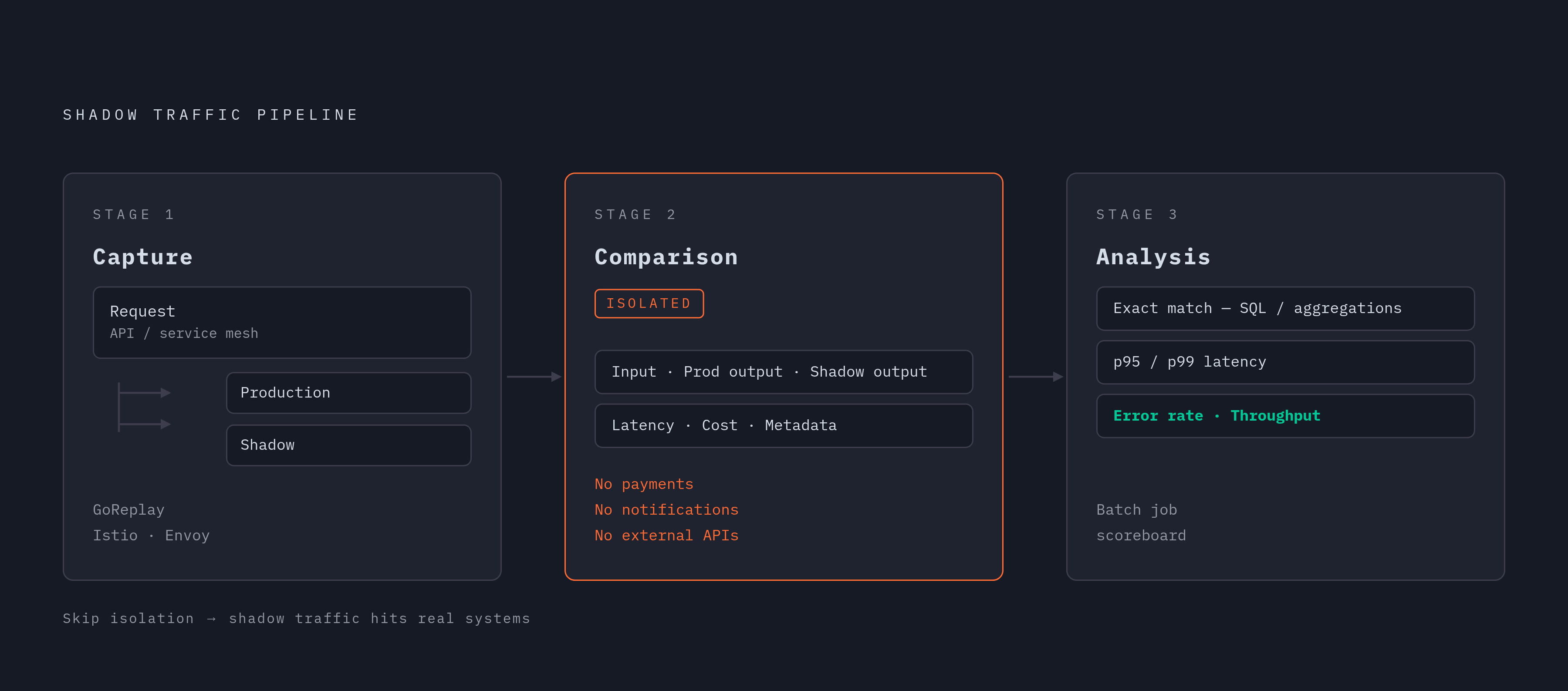
A working shadow traffic setup splits into three layers: capture, comparison, and analysis. Most of the engineering difficulty sits in the middle one.
The capture layer lives in the API gateway or service mesh, and it duplicates every request that comes in. The original goes to production untouched. The duplicate goes to the shadow deployment. Tools like GoReplay handle this capture and replay at the infrastructure level without touching application code. Teams already running Kubernetes can use Istio or Envoy to route shadow traffic the same way, with zero changes to the service itself. None of this is free, though: capture and replay use real CPU, memory, and network capacity on the capture host, and that cost needs planning the same way any other production resource does.
The comparison layer is where the complexity concentrates, because it has to store a lot more than a single response. It needs the original input, the production output, the shadow output, latency and cost for each side, any structured fields or confidence scores the pipeline returns, and enough metadata about the request to slice the results meaningfully later. The one non-negotiable rule of shadow traffic lives here: downstream services like payments, notifications, and external APIs have to be isolated, so a replayed request can never trigger a real side effect. Skip this step, and shadow traffic stops being a safe validation method. It becomes an uncontrolled experiment running against real systems, which is the opposite of what it's supposed to be.
The analysis layer runs periodically, often as a batch job, and it computes comparison metrics across everything logged in the comparison layer. For analytical pipelines where the output is deterministic, a SQL result set, an aggregated metric, this comparison can be exact: does the shadow output match the production output, yes or no. That precision is one reason shadow traffic suits analytical pipelines so well. There's no ambiguity about what a correct answer looks like, which makes the whole validation loop easier to trust.
What shadow traffic exposes in analytical pipelines
Shadow traffic surfaces a category of failure that stays invisible in staging and appears only when production traffic creates the conditions that trigger it.
Start with data skew. Production queries have long tails: unusual phrasings, multilingual mixing, inputs that are unexpectedly adversarial, all of which expose brittleness that a synthetic benchmark was never built to find. The gap between how a pipeline performs on an eval set and how it performs on real traffic is one of the most consistently underestimated risks in pipeline engineering. Shadow traffic closes that gap directly, by running real production queries against the candidate before it ever ships.
Schema drift is the second failure shadow traffic catches early. Running shadow traffic against a candidate pipeline surfaces a renamed column or a changed data type on the source side immediately, because the candidate diverges from production in a way that's easy to spot. Catching that drift in the shadow layer, rather than after it's already flowed into production, closes the window where bad data moves downstream undetected.
Then there's what averages hide. A scoreboard comparing p50, p95, and p99 latency, throughput, error rate, and resource pressure between production and shadow shows tail behavior that an aggregate benchmark simply can't. The practical acceptance thresholds are: p95 latency within a small positive margin of production, p99 not regressing past a defined ceiling during peak load, error rate at or below production's own rate. Teams that have run shadow validation on major pipeline changes report cases where a database query optimization looked strong against synthetic benchmarks, but shadow testing against real traffic then revealed specific user queries that performed worse under real conditions, so the problems got fixed before the change ever reached production and before peak season arrived.
Resource contention is the last piece, and it appears only under real concurrency. Tail latency spikes, retry amplification, thread exhaustion, autoscaling delays: none of these appear in a controlled test, because controlled tests don't generate the uneven load patterns that trigger them. For analytical pipelines that route reads through object storage, shadow traffic also exposes a cost problem that's easy to miss: running shadow and production simultaneously roughly doubles the read request count, and that cost amplification needs to be budgeted for before shadow traffic runs at any real scale.
Sampling strategy for shadow traffic
You can run shadow traffic at full production volume, and it puts not a single user at risk. The real constraint is evaluation cost, not capture volume, and that distinction shapes how teams should actually run it.
Capturing all traffic costs almost nothing in terms of risk. Evaluating every shadow pair is a different story: that's where compute and, for agentic or LLM-based systems, judgment cost adds up fast. A tiered evaluation strategy matches the method to the cost. Deterministic checks, the kind that work for SQL results or aggregated metrics, can run on every single shadow pair, because they're cheap and they catch most regressions. Expensive evaluation, human review or a strong model acting as judge, should run on a small, deliberately chosen fraction, focused on the query types where a regression would carry the highest downstream cost: the fraud detection pipeline, the pricing engine, the queries that feed a decision with real financial weight.
Full capture with full evaluation makes sense in narrower windows: right before a major cutover, during the first days after a schema change ships, or whenever a pipeline feeds a system where even a brief lapse in quality is expensive. Outside those windows, tiered sampling keeps the signal strong, so you don't burn compute on pairs that don't need the expensive treatment.
One more point matters here: shadow traffic works best as a continuous practice, not a one-time gate before launch. Treating it as a pre-launch check misses the regression risk introduced later by a change to upstream schema, a shift in query patterns, or growth in data volume that nobody flagged. Running shadow continuously also means it never goes stale the way a frozen benchmark does, because it's always comparing against whatever is actually arriving right now.
How AI agents change what shadow validation must measure
AI agents query analytical pipelines differently than people do, and shadow validation has to change to reflect that rather than assume the same techniques carry over untouched.
Agent-issued queries are often non-deterministic, session-dependent, and multi-step. Replay a single query from an agent session in isolation, and its meaning can change entirely if the prior steps in that session aren't replayed alongside it. A query that made sense as step four of a six-step session might look like a phantom regression on its own, when the real issue is missing context, not a broken pipeline. Agents also probe data at a pace no human analyst matches: where a person issues queries one at a time, an agent can fire many in rapid succession, and shadow infrastructure needs to be sized for that concurrency.
That changes what the comparison layer has to do. Session context needs to be captured and replayed as a whole unit, not as individual queries pulled out of sequence, to avoid flagging divergences that are really just artifacts of missing context. Agents operating in read-only, isolated compute environments over shared data, which is the right architecture for agentic access generally, actually simplify one part of this: there are no write side effects to suppress. But the isolation boundary around that read-only access still has to be enforced and checked, not assumed. And every agent query needs to be logged in full, because without a complete record of a multi-step session, attributing a regression to a specific step becomes close to impossible.
The comparison metric itself gets harder too. A deterministic SQL result either matches production or it doesn't, but an LLM producing a shadow response can't be expected to produce an identical output to its production counterpart, even when both are working correctly. Identical outputs aren't the bar. Semantic equivalence is, and the evaluation framework built around agentic outputs has to measure for that directly rather than reach for exact match and call the mismatch a regression.
Operational discipline that makes shadow traffic reliable rather than noisy
Shadow traffic only produces trustworthy signal when regression attribution is systematic. Teams that treat it purely as infrastructure, wiring up the capture and comparison layers and stopping there, end up sitting on a pile of logs they can't actually diagnose.
When a shadow comparison flags a quality drop, the real question is where the drop came from: the pipeline change itself, the evaluation metric, sampling bias, or plain non-determinism. To answer that, you need comparison logs sliced by query type, data shape, input length, and user segment. Without that slicing, a team can spend days chasing a divergence that turns out to have a one-line explanation sitting in the metadata the whole time.
A few observability requirements separate usable signal from noise. You need enough metadata attached to every shadow pair so you can filter by query category, time window, schema version, and traffic source. The scoreboard comparing production and shadow needs to show p50, p95, and p99 latency, throughput, error rate, and resource pressure, not averages, because averages hide the tail regressions that matter most. And the failure modes that only appear under real concurrency need to be correlated with the specific traffic patterns that caused them, not just logged as events that occurred.
A few habits turn this discipline into theater: running shadow validation once, as a gate before launch, misses every regression introduced after cutover. Watching only aggregate metrics misses tail regressions that hit a small share of queries but a large share of perceived latency. Leaving a shadow environment's downstream dependencies unisolated turns a validation method into an uncontrolled experiment running against real systems. And skipping write suppression for any pipeline that touches a transactional store defeats the entire premise: a shadow that can commit writes isn't shadow traffic.
What ties all of this together is a governance shift. Shadow traffic holds up as a long-term practice only when the shadow pipeline is treated as a first-class production concern in its own right: its own resource allocation, its own SLO for evaluation latency, and an owner whose job includes acting on what the scoreboard shows. You don't run shadow traffic through once and check it off as a testing phase. It's a standing validation posture, one that runs for as long as the pipeline itself keeps changing, which, for any real-time analytical system, is indefinitely.