Stateful vs Stateless Agent Query Sessions in Analytics Backends
Agent queries demand stateful backends, but stateless designs hide costs until concurrency scales.
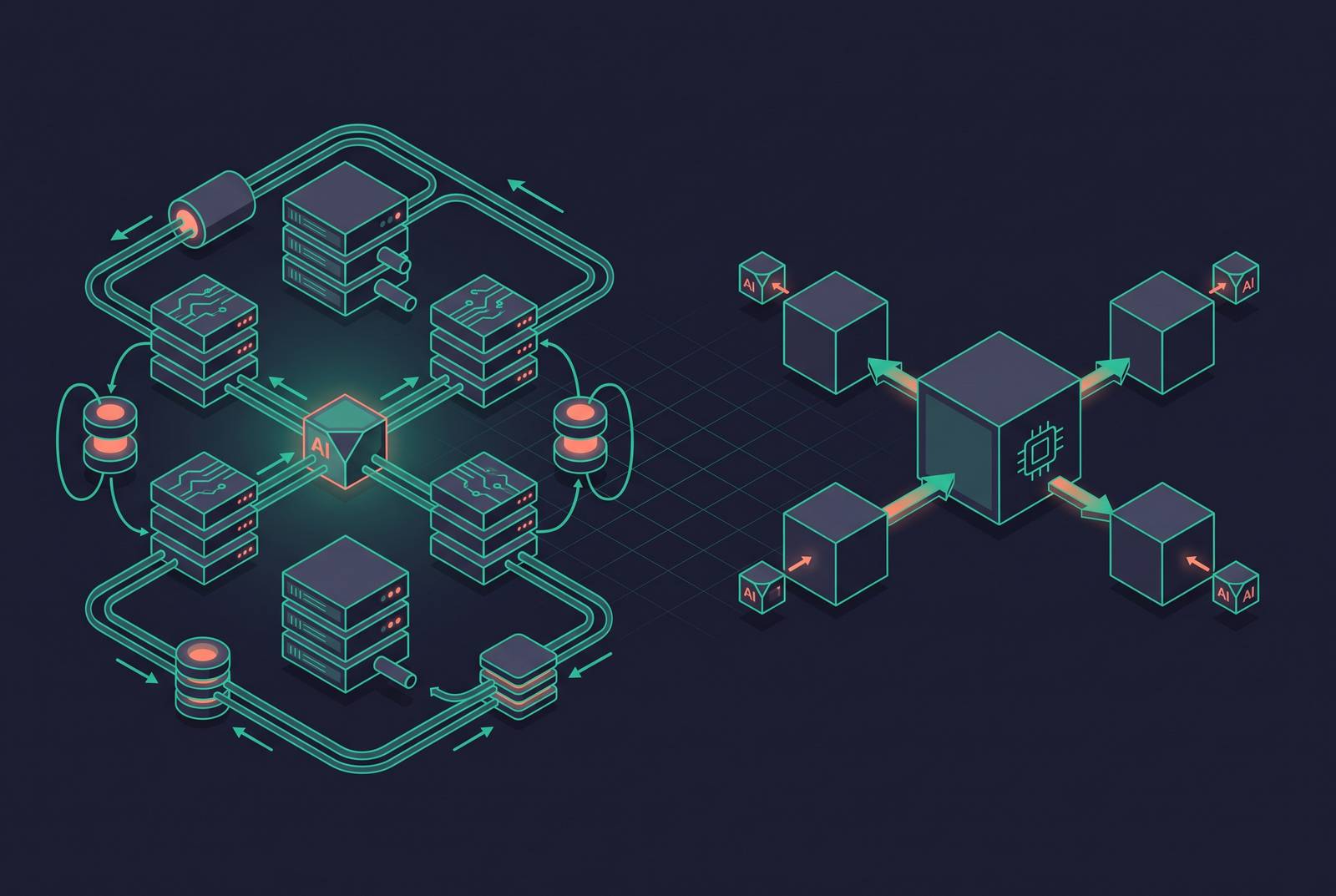
Agents have become the dominant traffic source hitting analytics backends, and the shift happened so fast that most infrastructure teams haven't caught up. MotherDuck's analysis of its own query history found that agents ran 29 times more queries than humans, a gap that has roughly doubled every month, and the average organization now runs with twice as many agents as human users. Agents don't behave like the people they're replacing either: they're non-deterministic, they operate at speeds no human can track in real time, and they probe data iteratively rather than waiting for a dashboard to refresh. So this combination produces volume, concurrency, and session behavior that most analytics backends simply weren't built to handle. What follows is an architectural problem, not a tuning exercise, and treating it like the latter is how teams end up rebuilding under load.
The collision gets sharpest at true scale, when the query volume, concurrency, and session churn agents generate outstrip anything a retrofit can absorb. ObsessionDB's architecture isolates agent compute over shared data, with full query logging and read-only access built in from the start, which makes it a foundation suited to the parallel, iterative probing patterns agents produce rather than a patch applied after the fact.
Stateless and Stateful at the Data Layer, Not the Model Layer
The distinction that matters here is a property of the session architecture wrapped around the language model, and mixing the two up produces systems that fail in ways that are entirely predictable once you know what to look for.
Start with the model layer, where people get the distinction wrong first. Every major LLM API is stateless by default: GPT-4, Claude, Llama, none of them remember anything between calls unless the calling code explicitly re-sends the context. When an agent appears to "remember" something, that memory comes from client-side state that the calling code re-injects on every request, or from a separate stateful runtime layer managing session, memory, and tool state on the model's behalf.
Now move down to the data layer, where the real engineering decision lives. A stateless agent session treats each query as a standalone transaction: no session lookup, no persisted context, everything the agent needs gets embedded in the prompt or re-sent with every call. A stateful agent session works differently. The agent reads prior state, things like session ID, workflow progress, accumulated query context, from an external store before it builds the next query, then writes the updated state back once the result comes in.
Neither one is automatically correct. The 2026 practitioner consensus settled on a hybrid: a stateless LLM wrapped by a stateful runtime, treated as the conservative default for production multi-turn workloads. Four dimensions separate the two designs most sharply where analytics backends are concerned: query volume per resolved task, token cost per session, how well the system scales horizontally, and how auditable the record is of what got asked and when.
How stateless session design interacts with the iterative probing patterns agents produce
Picture an agent drilling from a summary number down into the transaction-level detail behind it, refining a hypothesis, pulling together context across several dimensions before it can answer a question. Each step depends on what the last query returned. A stateless session has no way to hand that forward. It has to rebuild the whole picture from scratch, every single call.
That rebuilding isn't free. When a session resends full context on every call, it loses the benefit of prefix caching, the mechanism that lets a backend reuse a stable prompt prefix across requests instead of reprocessing it each time. At the query volumes agents generate, you don't give up that caching benefit as a rounding error. This loss is visible directly in token spend.
The clearest signal is calls per resolved task. Stateless designs tend to need more round trips, because context has to be rebuilt or re-sent with each one, while a well-managed stateful runtime can resolve the same task in fewer calls that each carry more information. More round trips mean more queries open simultaneously at a backend already serving high-concurrency agent workloads, each one competing for the same backend resources as every other agent running at the same time and compounding the concurrency load rather than easing it.
A real-time analytics database built on cache-mesh architecture, which is the approach ObsessionDB takes, removes some of the pressure that drives this pattern: by keeping hot data in memory and pricing on compute hours instead of per query, it takes away the economic incentive to minimize round trips that stateless designs otherwise create. Without session context, agents also tend to re-query data they've already pulled, which just adds more I/O load on top of everything else.
Where stateful session design fails under agent-scale concurrency
None of this means stateful is the safe choice by default. Stateful designs carry their own failure modes, and most of them stay invisible until concurrency climbs to where real agent deployments actually run.
The most common one in production looks like memory loss, but it's really a routing problem. Session history ends up pinned to one instance, and the moment a load balancer sends the next request somewhere else, the agent loses every bit of prior context it had built up.
Concurrency makes things worse in ways sequential testing never catches. When multiple agents write to the same session key at once, you get stale state from overlapping writes, partial updates that never fully land, and race conditions that simply don't show up when you're testing one agent at a time.
There's a slower failure mode too: prompt drift. As session state accumulates, it increasingly shapes the queries that come after it, in ways that get harder to predict and harder to audit the longer the session runs. Errors introduced early in a session don't stay contained. They propagate forward into everything that follows. Stateful AI systems can develop persistent biases or keep acting on corrupted state for extended stretches, and machine learning systems make this worse because errors get carried forward in memory rather than resetting with each call.
The lesson is to treat the state paradigm as a decision made before prompt design starts, not something bolted on afterward: retrofitting session memory into a system built stateless usually means tearing out the orchestration layer and starting over. Fixes exist and they're well understood: Redis or pinned sessions for state that needs stable routing, explicit tiering of state by lifecycle (run, session, user, long-term memory) with its own eviction rules per tier, and centralized caching so state is available to whichever instance ends up handling the next request. The failure modes here, localized amnesia, stale overwrites, cascading session cleanup, point toward a backend that treats session state as a concern of the data layer rather than something the runtime alone has to manage. Because ObsessionDB gives agents read-only isolation and logs every query in full, you can push session context out to a durable external store cleanly, without recreating those same failure modes inside the database itself.
The four types of agent state and the backend each requires
A lot of these failures trace back to one design mistake: treating all agent state as a single undifferentiated blob. State actually breaks into at least four distinct types, and each one has its own lifetime, its own storage requirement, and its own backend implications.
Run or session state lives for the length of a single task or conversation. It's keyed to a session ID and it dies when the session ends, which makes in-memory storage or Redis the right fit. Conversation state spans multiple turns within one interaction, holds message history and intermediate reasoning, and it typically lives in Redis or a short-lived document store. User state persists across sessions entirely, things like preferences, past decisions, account context, and that calls for a durable database rather than anything ephemeral. Long-term memory is the durable knowledge an agent accumulates over time, often embedding-based and queried by similarity, which points to a vector store.
Analytics work adds a fifth category that most agent frameworks don't account for explicitly: intermediate query results. Partial aggregations, drill-down paths, schema fragments assembled midway through a session, all of this is state too, and most frameworks have no tier for it even though analytics backends have to handle it at real volume.
The practical risk is conflation. If you keep run-scoped state in a durable database, the system gets too expensive to run at scale. If user-scoped state lives only in a session, it disappears the moment that session expires, even though it was supposed to persist. Each tier needs its own eviction rule, its own consistency requirement, its own scaling profile, and getting that wrong in either direction produces a system that's either bloated or fragile.
Audit and security requirements agent sessions impose on analytics backends built for humans
Agents querying across many parallel sessions create a threat surface that session-bound security tools were never built to see, and the stakes here go well beyond cost or performance.
CSTM-Bench research found that AI agent guardrails are memoryless: each message gets judged on its own, in isolation, and an adversary who spreads a single attack across many separate sessions slips past every session-bound detector, because no single message carries the payload. Only the aggregate does. A detector built to evaluate one message at a time cannot see a pattern that only exists across dozens of them.
The usual enterprise fallback, streaming every alert into a SIEM and correlating after the fact, doesn't close that gap. It's expensive, it's slow, and for agentic systems it's the wrong shape of solution entirely, because by the time a SIEM query fires, the action it would have flagged has already happened. The architectural answer that CSTM-Bench points toward is a bounded-memory Coreset Memory Reader, a system that ranks and retains the highest-signal fragments across sessions instead of treating each one in isolation. It was the only reader in the CSTM-Bench evaluation whose attack recall held up under both dilution and cross-session rewriting.
Audit logging runs into a related problem. Without session context preserved and logged, a backend cannot tell whether an agent that queried a dataset many times was legitimately probing it or exfiltrating it piece by piece. Add semantic blindness on top of that: without business context built into governance, an agent can't tell data it was meant to access apart from data it merely has the technical permission to reach. Left unchecked, it queries things it shouldn't touch and pushes the resulting errors downstream into whatever consumes its output next.
What MCP's stateful session model adds and leaves unsolved
MCP sits between stateless LLMs and the analytics databases they query, and it keeps track of context across requests that agents would otherwise lose. It also introduces new constraints, particularly around serverless deployment and security, that backend teams still have to solve on their own.
MCP is an open standard Anthropic introduced in late 2024, built to standardize how AI applications connect to external data sources and tools. Instead of a many-to-many integration mess, where every agent framework needs custom code for every data source, it turns the problem into something closer to many-plus-many: each side implements the standard once. Unlike a REST API, an MCP connection is stateful. The client and server hold a session together, so the server can carry context across multiple requests within one workflow, which matters directly for multi-step database operations.
That statefulness lives at the protocol layer, not the analytics layer. It doesn't replace the tiered state management a backend still needs internally, and it doesn't log query intent in a form an analytics system can actually use for auditing. A backend that adopts MCP and assumes query intent is now fully audited will find out otherwise the first time a regulator or a security team asks what an agent actually queried and why.
Serverless deployment runs into a structural wall here too. Because MCP is a stateful protocol, a stateless function runtime can't serve it without session affinity, which shapes how analytics platforms are able to expose MCP endpoints at all. Security research on MCP has flagged malicious code execution, remote access control issues, credential theft, and gaps in authentication and authorization: the protocol adds a session surface that needs active governance, not a one-time configuration pass. MCP is genuinely useful as an integration standard. It is not, on its own, a governance layer.
Columnar schema design and stateful agent query sessions at volume
Whatever advantage a stateful session offers only materializes if the backend underneath it can actually use the context the agent hands it. Schema design is where that advantage gets realized or wasted.
Columnar engines read data as contiguous streams of typed values, which is what aggregations, GROUP BY operations, and filter-heavy analytical queries need to benefit from cache locality, vectorization, and compression all at once. That architecture happens to match what agents do most of the time: their queries skew analytical rather than transactional, so this is the engine design they benefit from most directly.
Schema discipline multiplies that advantage. Denormalized tables, time-based partitioning, and clustering on the columns agents filter on most often all shrink the amount of data a query has to scan. For wide tables in telemetry or observability settings, that reduction in I/O can be substantial. Array-typed columns for repeated or hierarchical attributes inside a single fact table remove the need for joins while still allowing multidimensional analysis, a pattern that fits agents assembling context across several dimensions in one pass instead of stitching it together across a chain of joins.
Prefix caching only pays off if the backend returns results fast enough that the session context is still fresh when the next call comes in. A slow backend erases the latency advantage that stateful design is supposed to provide, no matter how well the session layer itself is built. A stateless session that resends full context on every call tends to produce full-scan query patterns even when partial results already sit in memory somewhere, so a schema built for stateful, iterative probing, narrowing partition filters turn by turn, performs measurably worse once the session design underneath it goes stateless. They're one decision, made in two places, and getting one right while ignoring the other leaves most of the performance gain on the table.
Sources
- One post tagged with "stateful vs stateless agents" | MLflow
- Stateful vs Stateless Agents. The distinction between stateful and… | by Mausumi Ranasingh | Mar, 2026 | Medium
- Stateful vs Stateless AI Agents: A Practical Comparison | Tacnode Blog
- Cross-Session Threats in AI Agents: Benchmark, Evaluation, and Algorithms
- Agents Don't Query Like Humans Do
- Managing State in AI Agents: A Practical Framework