OLAP vs OLTP Architecture Fit for Real-Time Customer-Facing Products
OLAP and OLTP need separate engines for real-time customer analytics.
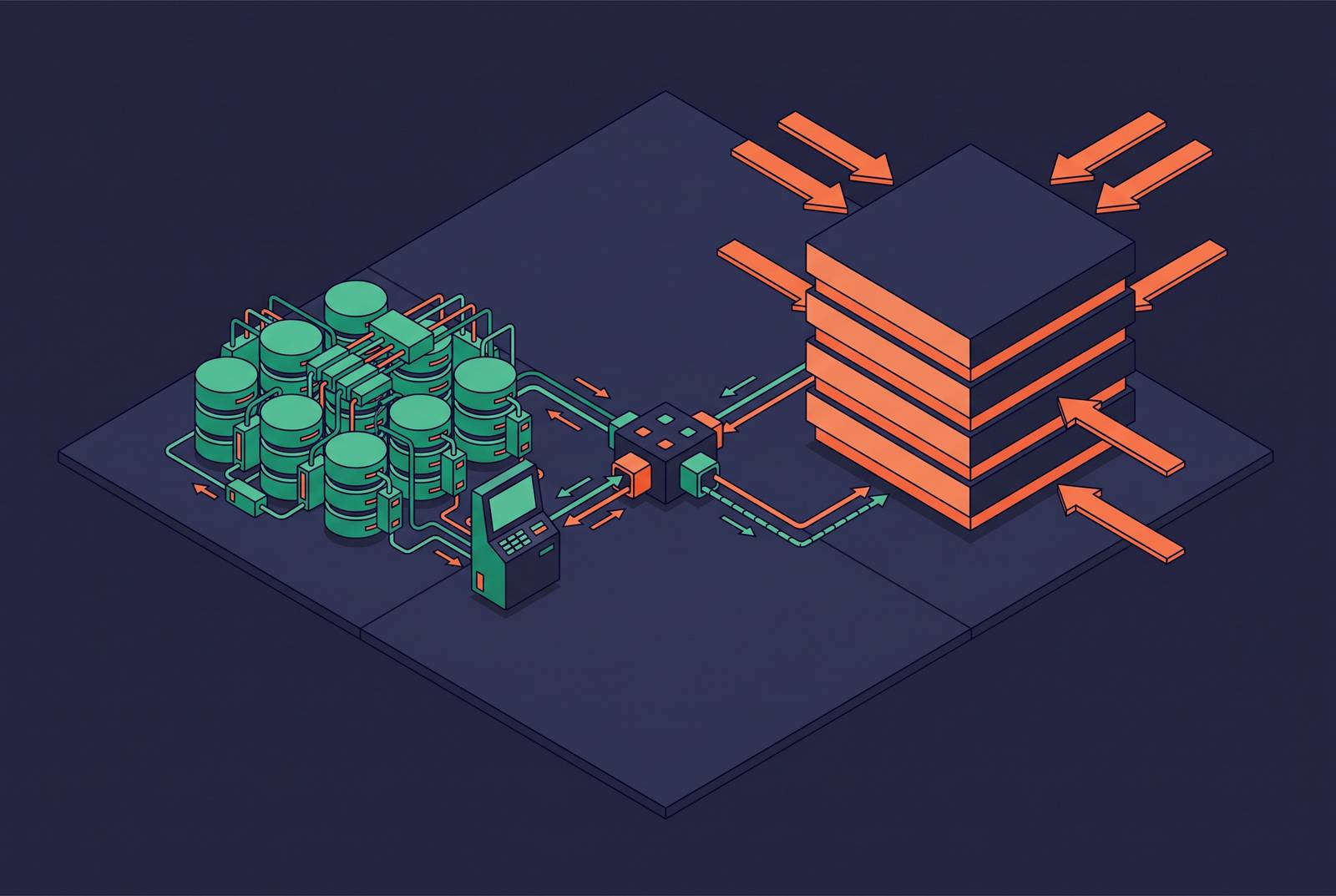
Picture a SaaS product with a usage chart embedded in every customer's dashboard, updating live as events come in. Or a marketplace showing a fraud score on each transaction. Or a leaderboard that moves the moment a new score lands. Each of these is an analytical query, an aggregation over a large dataset, dressed up to behave like a simple operational lookup. That's the mismatch this piece is about: customer-facing real-time analytics carries the query pattern of OLAP but has to meet the concurrency and latency bar of OLTP. A back-office BI dashboard can tolerate an overnight refresh. A customer-facing product where the data is an hour old is a bug customers will report.
What the storage layout difference means for query performance
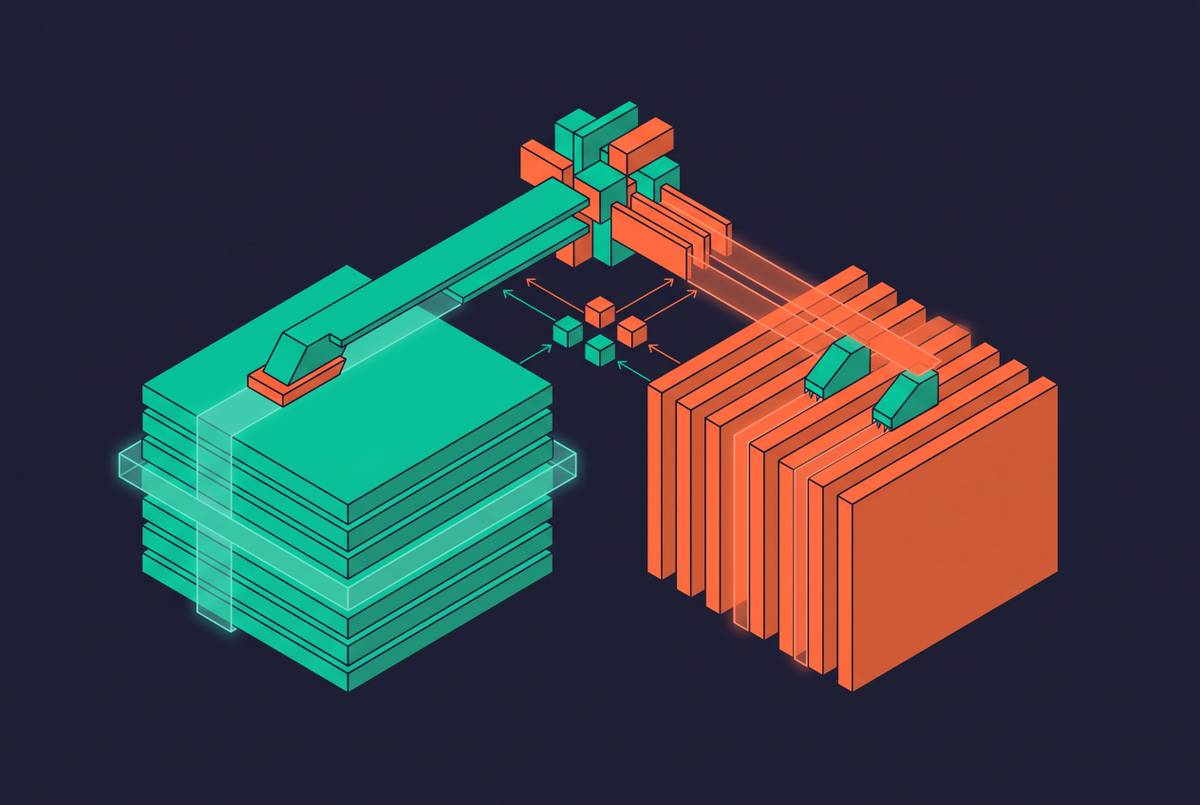
The OLTP/OLAP split isn't a marketing category. It comes from two opposing decisions about how data sits on disk, and those decisions make each engine bad at the other's job by design, not by accident. Row-store databases keep every column of a record together, so one read can pull back the whole entity. That's fast for point lookups and writes, but wasteful for an analytical scan that only needs a few of fifty columns. Column-store databases do the opposite: a query touching three of fifty columns reads only those three, and long runs of similar values compress well. Columnar storage also enables vectorized execution, so the engine processes batches of values through CPU pipelines instead of one row at a time, and compression cuts the volume of data that has to move before processing even starts. For a customer-facing product, that's not a minor performance gap. A row-store database asked to serve analytical queries at customer-facing volume doesn't just get slower, it degrades under load, because an access pattern it was never built for is now running at OLTP-level concurrency.
Why schema design choices in OLAP carry product-level consequences
Whether a schema gets normalized or denormalized isn't a style preference here. It decides whether queries come back fast enough, and whether the system holds up when load gets concurrent. OLTP schemas are normalized, typically to third normal form, because normalization prevents update anomalies when many writes hit the same data at once. OLAP schemas go the other way: star or snowflake schemas duplicate attribute values across millions of fact rows to eliminate joins, trading storage cost for read speed. On columnar storage, that storage cost mostly disappears into compression anyway. For customer-facing products specifically, joins compound latency under concurrency. When thousands of users hit the same queries at once, every extra join can turn into a bottleneck. Materialized views, pre-aggregated tables the engine maintains automatically, are the main tool for closing the gap between how complex a query is and how fast it needs to answer. They cost storage and some write amplification, but they deliver a near-instant read for a frequent query shape. Managed analytical database services built on cache-mesh architectures keep analytical data in memory, delivering sub-second latency while preserving the columnar efficiency that makes the queries scale. A team that lifts its normalized OLTP schema straight into an OLAP engine without redesigning it will get slow joins, poor compression, and query plans that undo the whole columnar advantage.
How the CDC-plus-OLAP pattern resolves the mismatch in practice
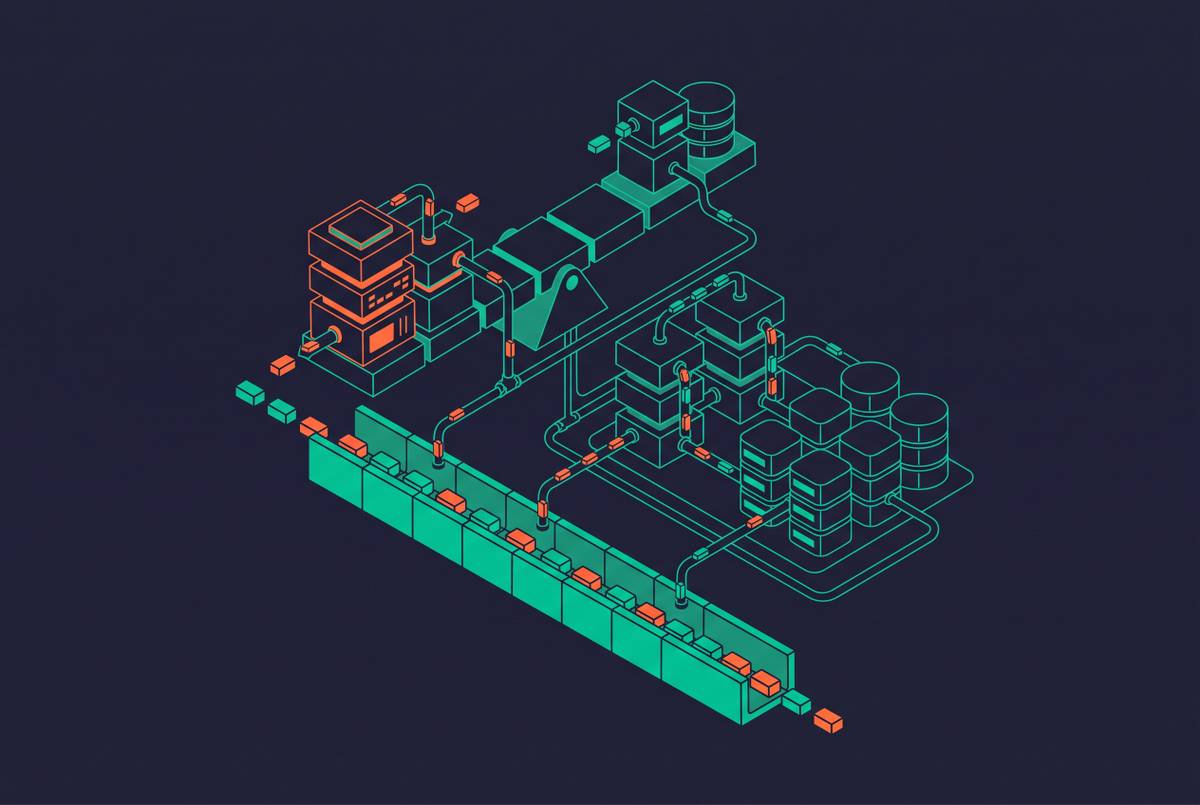
Most production teams don't try to force one engine to do both jobs. They keep two purpose-built engines and connect them with change data capture, because each engine doing one thing well beats a single engine that does both only adequately. The default architecture running through 2026 is to populate the OLAP side from the OLTP side through CDC, with a deliberate boundary: the OLTP database never gets slowed by analytical scans, and the OLAP database never has to handle point updates. CDC works by tailing the transactional database's write-ahead log, so it can stream every insert, update, and delete into the analytical store within seconds. Debezium running through Kafka is the open-source standard for this. The industry didn't just converge on this pattern through analysis, it validated it through money. Databricks acquired Neon and Snowflake acquired Crunchy Data in mid-2025, and both deals moved to own both sides of the split. If the largest vendors in the space, with every incentive to build a single unified engine, chose instead to own both halves of a paired architecture, that's a strong signal the pairing is the right answer. The pipeline does introduce a latency floor, the gap between a write landing in the transactional system and that write showing up in the analytical store. For most customer-facing analytics, single-digit-second freshness is fine. For a narrower set of products, it isn't, and that's where the next architecture comes in.
CDC latency limits and the trade-offs of streaming architectures
Fraud detection at the moment of authorization, real-time inventory allocation, live session analytics: these can't absorb even the seconds-level lag a CDC pipeline introduces. For that class of problem, a streaming database processes data before storing it. The older event-streaming stack chains together CDC, a message bus, a stream processor, and a serving database, and every hop in that chain adds latency along with its own operational overhead. Streaming databases collapse that stack. They ingest continuously from databases, event streams, and webhooks, process incrementally, and serve results as they're computed. Computation is event-driven with incremental updates, not triggered by a user query against stored data. The freshness gain shows up as end-to-end latency under this model running in milliseconds. Streaming databases that process before storing are built for freshness, not for the interactive, exploratory queries, ad-hoc aggregations over arbitrary slices of history, that a full-scan OLAP engine handles comfortably. Recovery models differ too. OLAP recovery usually means reloading from source or object storage, with the recovery point measured in load cycles, while streaming databases that checkpoint connector offsets can resume from the last checkpoint with no data loss, depending on what the engine persists and where. Freshness and query flexibility pull against each other. If you choose a streaming database for sub-100ms freshness, you accept real constraints on ad-hoc query patterns, so you need to know which dimension your product truly can't compromise on before you pick a direction.
The HTAP promise and the trade-off it narrows
What if a single engine could just do both? The benefit is eliminating CDC replication lag entirely for cases that need transactional writes and analytical reads on the same data at the same time, since the analytical view is derived from the same store. But the trade-off doesn't disappear, it just moves. Analytical scans and transactional writes now compete for memory, CPU, and I/O bandwidth inside one system, and the engine has to schedule and isolate them, a problem that purpose-built CDC-connected pairs sidestep entirely by putting each workload on separate compute. At customer-facing scale, millions of end users, hundreds of terabytes, high read concurrency, that intra-system contention becomes a ceiling. The CDC-plus-OLAP pairing scales each side independently, and that's a large part of why the industry has revealed its preference: the 2025 acquisitions show the two-engine model winning out for large-scale customer-facing workloads.
AI agents and query load on customer-facing analytics systems
When AI agents operate on customer-facing data, they create a query pattern that fits neither classic OLTP nor classic OLAP. An agent translates a natural-language question into a structured query, runs it, checks whether the result actually answers the intent, and refines if not. That reflection loop generates several queries per user intent, not one, and it's read-heavy by nature. Agents also probe schemas and enumerate tables in ways human analysts rarely do. Retrieval-augmented agents pull large amounts of context from external systems before they answer, so you get bursts of read traffic across many tables at once. This pattern looks closer to OLTP's high-concurrency, many-small-reads profile than to OLAP's few-large-scans profile, even though the data volume and aggregation needs stay analytical. The mismatch from the opening sections is intensifying rather than settling down: agents make it sharper, not different. None of this is optional. Autonomous agents querying production data need full logging, every query, every tool call, tied to the session or key it belongs to, because autonomous doesn't mean unaccountable.
Requirements for an engine built for customer-facing real-time analytics
Four requirements have to hold at the same time, and no engine satisfies all four just by default. Sub-second query latency matters most at the p99 tail, not the median, because customer-facing products expose slow queries directly to users, and tail latency is what they perceive as quality. High read concurrency means thousands of simultaneous end-user requests, and each one expects the same speed the first user got, not just a handful of analyst sessions. Data freshness needs to be measured in seconds, not hours, because a customer-facing product showing stale data feels broken to the person looking at it regardless of the engineering reason behind it. Cost has to hold steady as data grows. If architectures route every query through object storage, you pay for that routing in both latency and egress cost, and both compound as data volumes climb into the hundreds of terabytes. For agentic workloads running against the same data, the system needs isolated compute so exploratory agent queries don't contend with user-facing ones, full query logging for auditability, and sandboxed access that lets agents probe real data without touching production state. And the analytical schema itself needs to be treated as code, something that can be described, validated, and deployed, rather than a configuration someone manages by hand in a console.
How managed real-time OLAP options compare on these requirements
Managed real-time OLAP services mostly separate on three things that matter for customer-facing products: how they route queries relative to storage, how they price high-concurrency and agentic workloads, and what support they give during migration.
ObsessionDB is built directly around the mismatch this piece has been describing: OLAP query patterns running at OLTP concurrency and latency, on data that grows into the hundreds of terabytes. Its cache-mesh architecture keeps hot data in memory and never routes queries through S3, which answers the cost-and-latency compounding problem that S3-routed architectures run into as data scales. Compute is separated from storage, with S3 handling durability and an NVMe cache mesh handling speed, so each side scales on its own instead of forcing a step-change in cost as the product grows. Agentic workloads get isolated, read-only compute over shared data, every query gets logged, and sandboxed branches let agents experiment against real data without touching production. CHKit gives agents structured commands to describe, validate, and deploy schema and pipelines as code, treating the analytical schema as an engineering artifact. Migration is handled as a project, with engineers and benchmarks involved, not left as a documentation exercise a team works through alone.
Apache Druid is purpose-built for streaming ingestion and time-series analytics, with native Kafka and Kinesis support and pre-aggregation through rollups that shrink the storage footprint. The trade-off: there are no SQL row-level UPDATE or DELETE statements, updates and deletes require reindexing through REPLACE…OVERWRITE, SQL completeness is limited, and joins need deliberate schema design to perform at scale. Operational overhead for self-managed Druid is significant, and managed options exist but vary in how much migration and schema support they actually provide.
Operational complexity at scale is non-trivial, and the cost model depends heavily on which deployment and managed wrapper you choose.
Apache Doris is an open-source, real-time analytical database that supports both batch and streaming ingestion, built on columnar storage and vectorized execution. It offers a compute-storage decoupled mode for cost efficiency and scalability, along with lakehouse integration with Hive, Iceberg, and Hudi for federated querying across data sources. It suits organizations that want an open-source option and are prepared to manage the operational layer themselves or through a third-party managed service.
Choosing the architecture that resolves the mismatch, not the one that fits a category label
The right architecture for a customer-facing real-time product is whichever one matches the query pattern, concurrency, freshness, and cost trajectory the product actually creates. It isn't about picking whatever carries the OLAP or OLTP label that sounds more official.
Start with freshness. If single-digit-second lag is acceptable, the CDC-plus-OLAP pairing is the most scalable and operationally clean choice you can make. If the product needs millisecond freshness, a streaming-first architecture becomes necessary, and the query-flexibility trade-off that comes with it needs to be accepted up front.
Apply the concurrency requirement next. HTAP earns its place only when simultaneous write and analytical read workloads are moderate and the cost of intra-system resource contention is genuinely lower than the cost of running a CDC pipeline. For most customer-facing products at scale, that condition doesn't hold.
Look at cost trajectory, not just today's bill. If architectures route analytical queries through object storage, they look cheap at small data volumes but get expensive fast at large ones. The cost model that looks competitive this year can be the one that caps the product's ambition two years out.
Plan for agents from the start, not as an afterthought. The query load an AI agent puts on a database is qualitatively different from human analyst load, and a system that isn't built for isolated, auditable, sandboxed agentic access will either block agent adoption outright or leave production data exposed to uncontrolled exploratory queries.
The decision sequence, in order: identify the one constraint that can't bend, whether that's freshness, concurrency, a cost ceiling, or agentic access. Choose the architecture whose design assumptions make that constraint tractable. Then choose the specific engine within that architecture whose economics match where the data volume is headed. The two 2025 acquisitions show the largest vendors in the industry arrived at that same conclusion by watching the market, not just by running the analysis.