Kappa Architecture Trade-Offs for Real-Time Analytical Pipelines
Simplicity comes with costs in reprocessing, late data, and query serving.
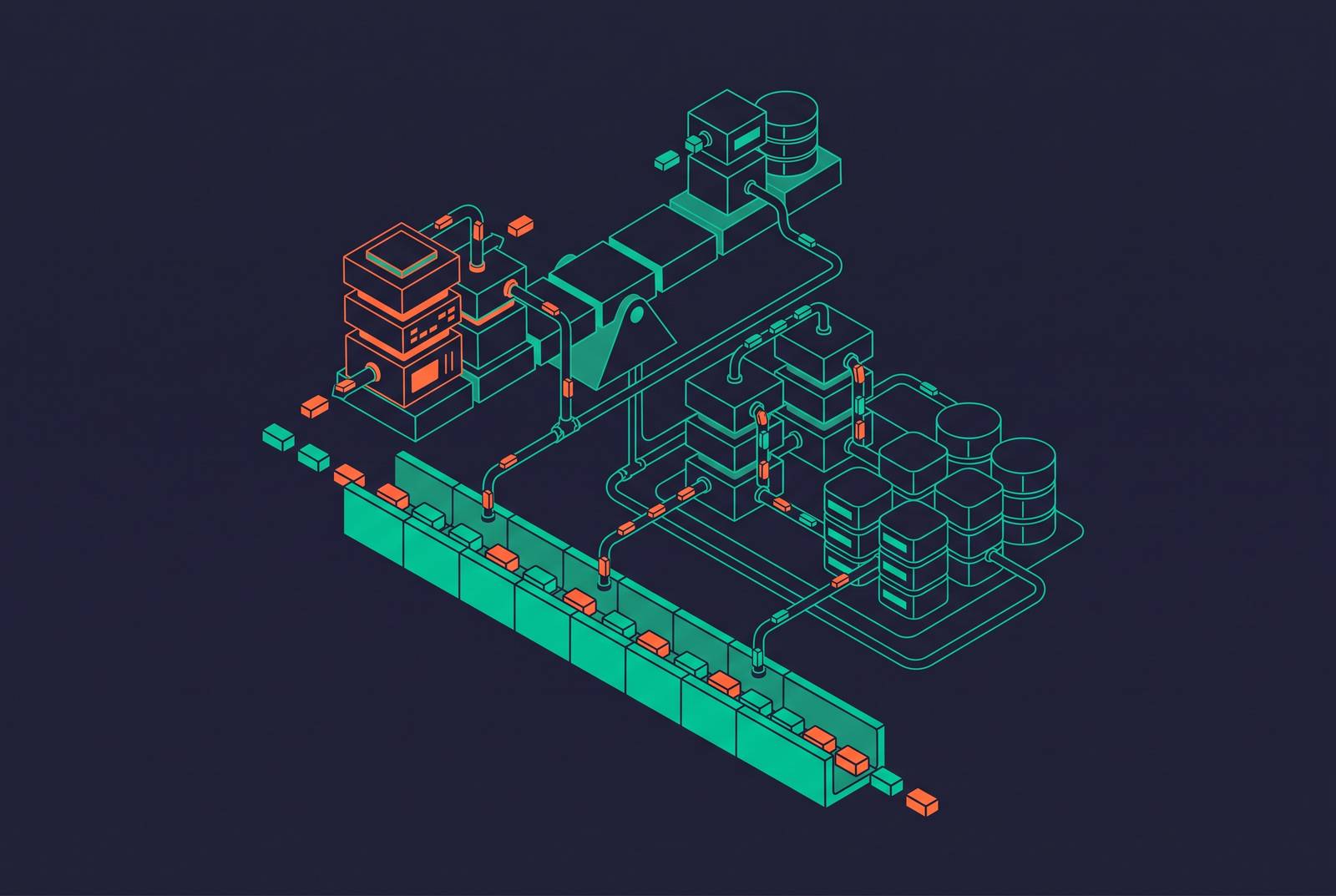
Kappa Architecture promises one pipeline where Lambda needed two. A single streaming path, it says, can replace the batch layer and the speed layer and still keep analytical correctness. The appeal is real, but so are the costs. The trade-offs show up most clearly in reprocessing, late data, and the serving layer.
Why Kappa Architecture emerged as a challenge to Lambda's two-pipeline model
Kappa Architecture's core proposition is that a single streaming pipeline can replace Lambda's separate batch and speed layers without sacrificing analytical correctness. In Lambda, the batch layer was the source of its accuracy advantage. It was also its scaling ceiling. As data grew, coordinating the two layers became what cost the most to run. Teams spent more effort reconciling outputs than building features.
Kappa's answer is to treat all data, historical and real-time, as an ordered, append-only stream. You reprocess history by replaying the log through the same pipeline used for live data. The log-centric design, typically Apache Kafka or a similar distributed log, is both the ingestion mechanism and the reprocessing substrate. One system, one codebase, one operational model.
The strongest objection is that eliminating the batch layer removes a proven tool for large-scale historical computation. Kappa's response is that the batch layer's value was always in reprocessing. Log replay can do that without a separate framework. Whether that holds up depends on the workload.
What Kappa actually simplifies and where the simplification is real
Kappa delivers real operational savings in specific, bounded conditions. Those conditions describe a meaningful class of analytical workloads. The single codebase is the biggest win. Transformations, filtering, and aggregations live in one place. A bug fixed once propagates correctly to both live and historical data without reconciling two outputs.
The reduced divergence risk matters just as much. Lambda's serving layer had to merge batch views with speed views. Disagreements between them were a chronic source of correctness problems. Kappa eliminates the merge step entirely. There is one output, produced by one pipeline.
The workloads that fit well are IoT event streams, real-time monitoring, click-event analytics, and observability pipelines. These share a common shape. Events are immutable, arrive in approximate order, and historical reprocessing is infrequent. Observability pipelines are a particularly clean fit. Log and metric events are append-only, late arrival windows are short, and reprocessing is triggered by rule changes, not routine operations. Horizontal scalability of the stream layer is well understood. Adding partitions and consumer groups scales throughput without redesigning the architecture.
Reprocessing at scale: why replaying the log is not the same as running a batch job
The critical turn comes when you need to reprocess history. Replaying months of events through a streaming engine is structurally slower than running a batch job over columnar storage. That gap widens as data volumes grow.
Batch engines processing Parquet files with columnar compression and predicate pushdown are designed to scan large datasets efficiently. Streaming engines process events sequentially or in micro-batches. That is the right model for latency but the wrong model for throughput at scale. A full replay of a large historical window also consumes the same streaming compute that handles live traffic. You get resource contention during exactly the moment when the team most needs both to run correctly.
Retention horizon is a compounding variable. The longer the required replay window, the more this gap matters. A 24-hour replay is manageable. A 90-day replay at high ingest volume is a different problem to engineer. Log retention itself carries cost. If you keep months of raw events, even with tiered storage, you need to plan on whether you need the full raw events. Compacted topics keep only the latest value per key, which may be enough for some workloads. Some teams run a parallel replay consumer group with throttled throughput. That extends the reprocessing window and delays correctness. It does not eliminate the structural ceiling.
Late-arriving data and the event-time ordering problem
Kappa's one-pipeline model has to absorb late arrivals with no batch layer to correct them. That forces watermarking and windowing decisions that are harder to change than they appear at design time. In Lambda, the batch layer recomputes accurate historical aggregates on a schedule. That provides a structural backstop for events that arrived after the speed layer's window closed. Kappa has no equivalent backstop.
Kappa's answer is watermarking. The stream processor defines a maximum acceptable lateness after which late events are dropped or routed to a side output. Every analytical guarantee downstream rests on that watermark holding. Watermark choice is a correctness-versus-latency trade-off baked into the design. Tight watermarks reduce latency but drop more late arrivals. Loose watermarks improve completeness but delay output and increase state size.
Mobile and edge-originated events, network partitions, and upstream system outages all generate late arrivals at unpredictable rates. The workloads that benefit most from real-time analytics are also the workloads most prone to late arrival. When a watermark decision turns out to be wrong, correcting it requires a full log replay. That loops back to the reprocessing cost. The two biggest trade-offs compound each other.
Serving layer pressure when the stream is the only source of truth
Eliminating the batch layer moves complexity to the serving layer. That layer must handle ad hoc analytical queries against data optimized for streaming throughput, not query performance. Log-based streaming systems are not designed for ad hoc queries or complex analytical workloads. To serve analytical results, you have to integrate external systems, columnar stores and OLAP engines that are internally closer to batch-oriented.
The stream processor writes to the serving store continuously. The serving store has to take high-frequency small writes and still answer large-scan analytical queries. These two access patterns pull in opposite directions. Schema changes in the source add another failure mode. A new column or a type change the connector does not propagate arrives at the serving store without a batch recompute to absorb it cleanly. The sink silently drops or nulls the new field. The error may not surface until a query returns wrong results.
Mutable workloads layer on more. Deletes and updates flowing through a streaming pipeline require the serving layer to implement upsert semantics. In columnar stores that means specific table engine choices and query-time correctness filters, such as FINAL reads or explicit is_deleted filters, applied the same way by every consumer. So Kappa's single pipeline often becomes Kappa plus a serving layer you have to engineer with care. Schema management, upsert logic, and query optimization do not disappear. They relocate.
How the serving layer's query performance problem connects to columnar storage and schema design
Serving real-time analytical queries at scale on Kappa's output requires columnar storage engineered for the specific query patterns of the workload. Not generic query paths. Columnar databases deliver orders of magnitude faster analytics through I/O reduction, compression, and vectorized execution. The gains are real, but they depend on data being organized to match the queries that will be run.
High query repetition in production analytical workloads means most deployments do not require full generality. Stable parameterized query templates can be accelerated through materialized views and pre-aggregation strategies. Pre-aggregation is a structural answer to ad hoc query load. A serving layer that pre-computes common aggregations at ingest time reduces query-time scan cost. But it requires knowing the query patterns in advance. That conflicts with the flexibility Kappa promises.
Sort key and partition key decisions made at schema design time determine whether a columnar engine can use predicate pushdown to skip irrelevant data. A schema designed for streaming write throughput is often the wrong schema for analytical read performance. Teams adopting Kappa for analytical workloads face a design fork early. Optimize the serving schema for the queries they know today, accepting that schema changes require coordinated pipeline updates. Or accept higher query-time cost in exchange for flexibility.
Reprocessing economics: the true cost of changing logic in a Kappa pipeline
In Kappa, changing business logic is never just a code change. It is a replay operation whose cost scales with data volume and retention horizon. That cost must be built into the architecture's economics from the start. Every logic change, a new aggregation rule, a corrected parsing function, a revised deduplication key, requires replaying the relevant portion of the log to backfill corrected results.
The replay window is not always obvious at design time. A bug in a metric definition might require correcting months of output, even if the pipeline is otherwise healthy. Log retention policy determines replay feasibility. If raw events are not retained long enough, or if compacted topics have collapsed the event history, full reprocessing is impossible. The architecture loses one of its defining properties.
Running a replay at full speed competes with live processing for compute and consumer group bandwidth. If you throttle the replay, the serving layer stays stale or only partly corrected for longer. The alternative that practitioners increasingly weigh is a Kafka-plus-columnar-store pattern. You get a clear separation between the streaming ingest path and a periodic correction mechanism. That accepts some batch-like behavior in exchange for operational clarity and lower replay cost.
Storage overlap between the two paths is a small fraction of total cost. The operational clarity of separate, well-understood components often outweighs the theoretical elegance of pure stream-first design. Sophisticated teams reach this conclusion after operating Kappa in production. The economics must be modeled honestly before committing.
Where Kappa's trade-offs are acceptable and where they are not
Kappa is a strong fit for a specific class of real-time analytical workload and a poor fit for another. The differences are concrete enough to evaluate before committing. Good fit indicators include events that are immutable and append-only, such as logs, metrics, click events, and sensor readings. Late arrival windows that are short and predictable. If logic changes are infrequent relative to data volume, replays are rare. Query patterns that are known and stable enough to support pre-aggregation at the serving layer. Observability pipelines are the canonical example. They are append-only, with short late-arrival windows and infrequent logic changes.
Poor fit indicators include historical reprocessing that is routine, such as regulatory recalculation or model retraining on corrected features. Late arrivals that are structurally unpredictable can come from mobile-originated events, edge devices, or third-party feeds. Business logic that changes frequently makes replay a recurring operational cost, not an exceptional one. Ad hoc analytical queries that dominate, where the serving layer cannot be optimized for a stable query template.
The hybrid reality is that most production systems that call themselves Kappa have reintroduced some batch-like behavior at the serving layer. Periodic recomputes, snapshot materialization, or a correction mechanism. That is not a failure of the architecture. It is an honest adaptation to analytical workload demands.
What the serving layer demands of the analytical store underneath it
A Kappa architecture's viability for analytical workloads depends heavily on whether the underlying store can absorb streaming write patterns without degrading query latency as data volume grows. The core tension is structural. Streaming pipelines write continuously in small batches. Analytical queries scan large ranges. Stores that optimize for one typically penalize the other.
If a store routes all reads through object storage, query latency grows with scan size. A query on billions of rows can take over 30 seconds without optimization. That is acceptable for batch workloads but problematic for sub-second analytical queries against hundreds of terabytes. A cache layer that keeps hot data in memory and off the object storage read path is not an optimization for this workload class. It is a prerequisite. Without it, p99 latency climbs as data volume grows. That moves exactly backwards from what a production analytical product can tolerate.
Agentic workloads add a new dimension to this pressure. AI agents query relentlessly and in parallel, often probing the same serving layer that human dashboards read. A per-query pricing model penalizes this access pattern, but a compute-capacity model does not. Agents also require full query logging for auditability. Autonomous access to production analytical data has to be traceable, especially when agents run exploratory or experimental queries against live serving tables. For teams running Kappa pipelines into a managed analytical store, the store's architecture determines whether the serving layer's query SLA is achievable at scale. The key question is whether reads go through object storage or hot data sits in a memory-resident cache mesh.
Schema management and pipeline-as-code as operational disciplines for Kappa in production
Operating a Kappa pipeline for analytical workloads at scale requires treating schema and pipeline configuration as versioned, validated code. Not as operational state managed by hand. Schema drift is Kappa's silent correctness risk. A source schema change that the pipeline does not propagate will null or drop fields at the serving layer without raising an alarm. The error compounds silently until a query returns wrong results or a downstream consumer fails.
Schema validation at the ingestion boundary catches drift early, when it can be handled, rather than late, when it requires a replay. Enforcing that new events conform to the expected schema before they enter the pipeline is the first line of defense. Pipeline logic as code extends the same discipline further. When you define transformations, watermarks, and serving-layer write patterns in version-controlled, reviewable artifacts, logic changes carry the same engineering discipline as application code. The change is reviewable, testable, and its replay cost is estimable before deployment.
Branching and sandboxing for logic changes completes the picture. To test a new pipeline version against real historical data without touching the production serving layer, you need a separate consumer group writing to an isolated serving environment, or a branched snapshot of the serving layer. This is the same discipline that makes agentic access safe. Agents experimenting with queries or exploring schema changes should operate against sandboxed branches, not production serving tables.
Tooling that gives both engineers and agents structured commands to describe, validate, and deploy schema and pipeline changes as code reduces the operational overhead of Kappa's inevitable evolution. It makes the replay cost of each change visible before the team commits to it. That is what Kappa done well looks like in production. Not a single pipeline free of complexity, but one where the complexity is named, versioned, and owned.