Retry and Backoff Strategies for Agent-Issued Analytical Queries
Distinguish four types of agent query failures and deploy the right recovery strategy for each.
An agent issues a query. The database returns rows. The agent reads them, treats them as fact, and moves on to the next step. Nothing in that sequence trips an alarm, because nothing failed in the way monitoring tools are built to notice: the HTTP status is 200, the connection held, the query ran to completion. The column name was hallucinated, the schema was misread, or the filter was fabricated, so the rows that came back are the wrong rows, returned cleanly.
Standard error handling was built to catch structural failures: timeouts, malformed requests, server errors. In production, multi-agent systems fail between 41% and 86.7% of the time, and specification ambiguity and unstructured coordination drive that, not API downtime. Schema enforcement at the database layer catches a query that is structurally invalid SQL. It does nothing for a query that is well-formed, fully executable, and aimed at the wrong partition.
How agents issue analytical queries
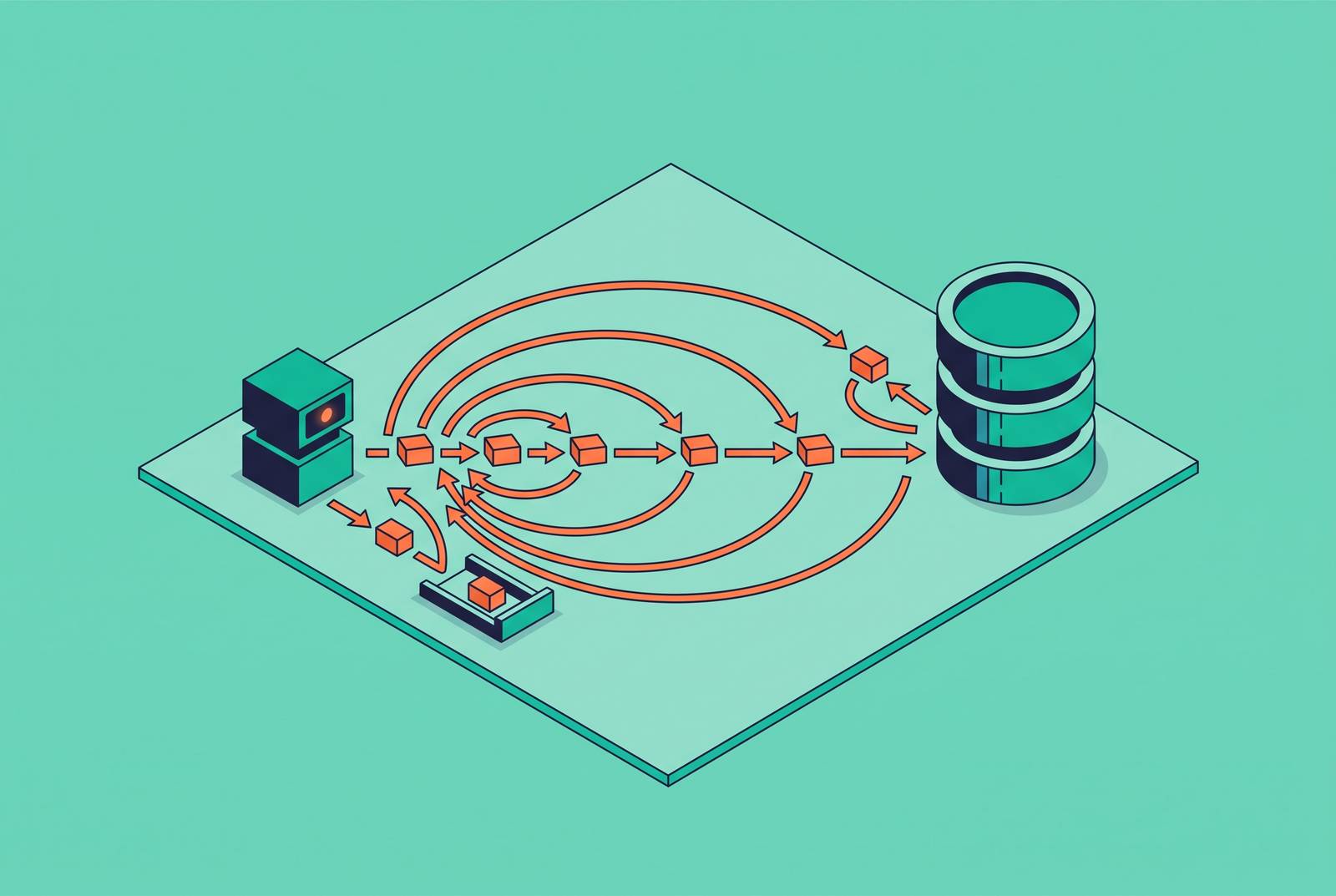
A human analyst writes one query, checks it, runs it. An agent runs a pipeline. A typical path looks like this: an orchestrator receives a natural-language request, a target search agent parses targets and validates permissions, a database querying agent handles endpoint selection and query construction and date-range processing, the query executes, a validation step checks the result against business rules, and if that validation fails, the loop sends control back to endpoint selection. So something can go wrong at five or six independent points before a human ever sees an answer. If a retry doesn't know which of those hops failed, it will either duplicate work that already succeeded or skip the step that actually needs redoing.
Concurrency compounds this. Each agent might be sending requests well under its own per-agent rate limit, with no way to see that the aggregate load across all of them has blown past the system's combined capacity. That thundering herd comes entirely from inside the system, not from any external actor.
AgentR treats its core entities (projects and papers moving through a research pipeline) as durable objects, governed by a six-state finite automaton with explicit transitions between processing states. That design choice exists for a specific reason: a multi-stage LLM workflow cannot be recovered unless the system knows which stage failed and what state had already accumulated before the failure.
The four failure domains agent query pipelines encounter
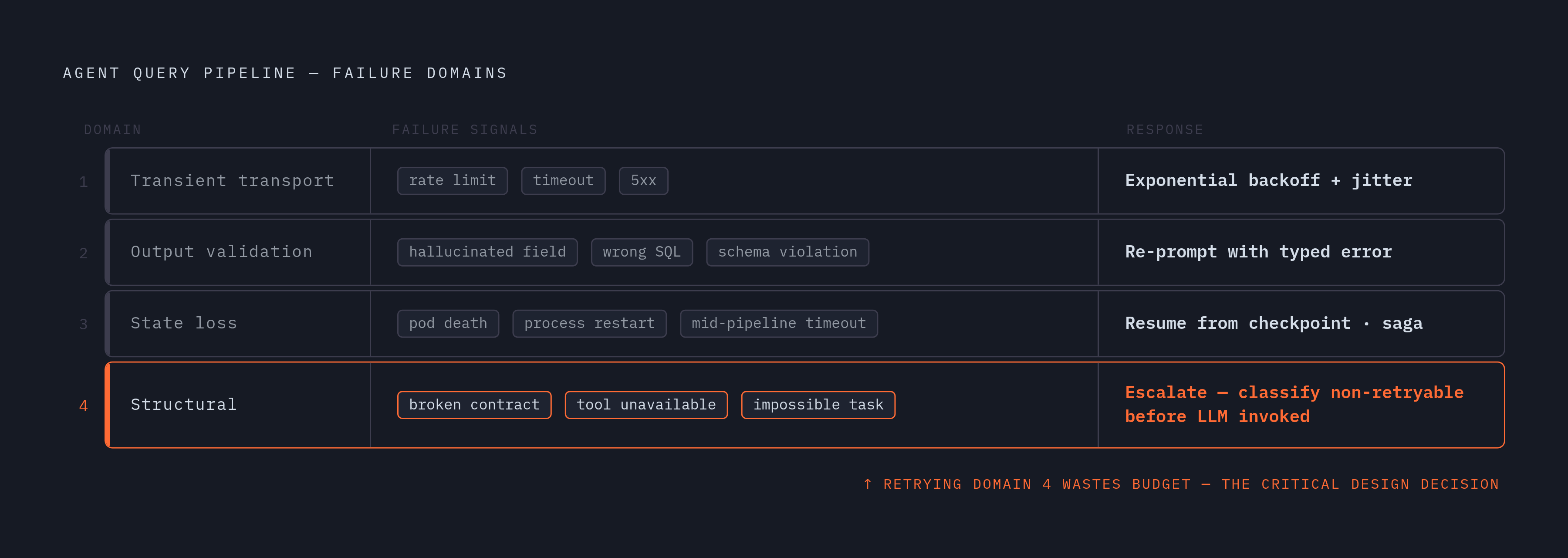
Four distinct things can go wrong in an agent query pipeline, and each one needs a different response.
Domain 1 covers transient transport failures: rate limits, timeouts, 5xx errors from the database or an upstream service. These resolve on their own. Retrying with backoff is the right tool here, and it's enough.
Domain 2 covers output validation failures. The model can return free text where structured output was required, invent a field name that doesn't exist in the schema, or produce SQL that violates a constraint. So you need re-prompting with a precise description of what went wrong.
Domain 3 covers state loss: the process restarts, the pod dies mid-run, the workflow times out partway through a multi-step pipeline. The fix is resumption from a durable checkpoint. A full restart from step one replays everything that already succeeded, duplicating any side effects those earlier steps produced.
Domain 4 covers structural failures: an API contract changed, a tool is unavailable, or the task is simply impossible given the current schema. Retrying these only wastes budget, since what they need is escalation to a human or a supervised correction path.
AgentR builds this taxonomy directly into its handling logic. Permanently non-recoverable failures (orphaned jobs) get detected before the LLM is ever invoked, so the pipeline terminates with no further cost incurred. That's the practical cost of skipping this classification: pointing transport-layer backoff at a Domain 2 failure burns through the entire retry budget reproducing the same hallucinated result, and pointing it at a Domain 4 failure sends a retry loop at a tool that was never going to respond.
Why context contamination defeats standard backoff
An agent calls the wrong endpoint, fails, retries within the same conversation thread, and calls the same wrong endpoint again. Why does this happen? Because the failed attempt is still sitting in the context window. The error doesn't disappear between attempts. It compounds.
This has a formal name now: the Context-Contaminated Restart Model, or CCRM, developed in research on multi-step LLM workflows. After any failed attempt, the next attempt no longer operates at that base rate. It operates in a contaminated context, with a strictly higher error rate than before the failure occurred.
That raises an important question: if retrying in the same thread makes each subsequent attempt worse, what's the alternative? The standard instinct (keep the conversation going, let the model learn from its mistake in real time) is, under this model, the worse strategy for analytical agents.
One might argue that clean restarts throw away everything the agent accomplished before the failure, and that objection is fair. The engineering answer under active exploration is selective context pruning: evicting the records of failed tool calls from context while keeping the record of steps that succeeded. This isn't settled territory. Several approaches are being built out in 2025 and 2026, including Anthropic's context editing API and various recency-based pruning frameworks, but you shouldn't treat any of them as a finished solution yet. The honest state of things is that clean restarts work, pruning is promising, and the field hasn't converged on one correct implementation.
Exponential backoff with jitter for analytical workloads
Exponential backoff with jitter is the correct tool for Domain 1 failures, full stop on that part. No multi-agent deployment should go without it.
The standard shape of this pattern is simple: a base delay in the low-second range, a multiplier (commonly 2x) applied per attempt, a randomized jitter offset layered on top, a ceiling on how long any single delay can stretch, and a bounded count on total attempts. AgentR uses BullMQ queues configured exactly this way, with the worker rethrowing the error so BullMQ returns the job to the queue with increasing delay between attempts. It's a solid reference implementation for the transport layer.
What backoff cannot do is remember. Attempt five has no knowledge that attempts one through four all failed for the same underlying reason. It's temporal spacing, not semantic correction. For analytical pipelines, that means backoff handles the rate-limit case well and says nothing at all about hallucinated SQL, schema mismatches, or context contamination, which happen to be the failures that dominate agent workloads in practice.
Extending circuit breakers to catch semantic degradation, not just HTTP failures
Backoff's blind spot is exactly where circuit breakers come in, and why the standard circuit breaker needs extending for analytical agents. If a breaker only tracks HTTP error rates, it will stay closed while an agent keeps producing semantically broken queries, because every one of those queries is returning HTTP 200.
The structure of the pattern doesn't need to change. Closed, passing traffic. Open, blocking it. Half-Open, probing to see if conditions have improved. What needs to change is what trips the breaker. For analytical pipelines, the breaker should open when the rate of queries failing schema validation or business-rule checks crosses a threshold over a rolling window, independent of what the HTTP layer reports. A system can be serving perfectly successful-looking responses while degrading badly, as prompt drift, a model checkpoint regression, or contaminated context build up across retries.
Without this kind of breaker, a multi-agent system has no internal brake. An agent will keep retrying a broken tool call indefinitely unless something external stops it, and that something has to be a circuit, not a timeout. The validation gate that feeds this breaker has to run before tool invocation, not after. An agent that calls the right tool with hallucinated parameters has already written a side effect to the database by the time a post-execution check could catch the problem. Analytical databases built for agentic workloads log every query in full, so a team can tell a hallucinated column name that executes with an HTTP 200 and returns wrong results apart from a genuine transport error, and can reconstruct exactly which query an agent issued and what came back. That logging requirement is what connects circuit breaking to the next layer: idempotency and state management.
Idempotency and checkpoint design for retryable analytical operations
A retry that isn't idempotent is a duplication. For agent-triggered analytical pipelines that include INSERT operations, materialized view refreshes, or staged aggregations, that duplication is a data corruption event, not a minor inconvenience.
Multi-step agent workflows don't come with idempotent intermediate states by default. If a five-step pipeline fails at step four and the retry logic restarts from step one, steps one through three run again, and whatever writes those steps made get duplicated right alongside them. The structural fix here is the saga pattern: for every agent action that has a side effect, define a corresponding undo action, keep a log of which steps actually executed, and when something fails, walk that log backward, running the compensating actions before attempting the retry.
Where the database supports it, atomic transactions handle this cleanly: wrap the write in a transaction block that can be rolled back with a single command. No data is lost, and the full sequence of states is sitting there for debugging later, which is exactly the property the next section depends on.
Autonomous doesn't mean unaccountable. An agent that retried twelve times and still landed on a wrong analytical answer needs to be traceable back to the specific context state and query construction that caused the failure, or there's no way to fix the pipeline going forward.
Traditional application performance monitoring captures request rate, latency, and error codes. Telling them apart requires looking at the semantic content of consecutive queries, not their timing or status codes. Tool calls, reasoning steps, state, and memory operations all need to be logged in full.
AgentR's own logging illustrates what this buys a system. It implements ACID token-cost logging alongside Type-2 slowly changing pricing records, and achieves 99.2% job completion at the LLM stage. That logging is the actual mechanism that lets the system detect orphaned jobs, check credit before invoking the LLM, and attribute cost to specific workflow stages.
A real-time analytics platform with isolated agent compute, the kind of architecture ObsessionDB builds for agentic workloads, can tell apart a coordinated thundering herd sourced from inside the system (many agents querying at once after a cache invalidation) from genuine external throttling, because every agent's compute is isolated and every query carries a log entry with its originating agent and timestamp. None of this works as an afterthought bolted onto an existing system. It has to be a property of how the database is built to serve agents from the start.
A practical retry design for agent-issued analytical queries, assembled from the failure taxonomy
Pulling the four domains together into one retry stack gives four independent contracts, each scoped to the failure type it's meant to catch, with clean-context restart overriding the others when contamination is detected.
Layer 1, transport, covers Domain 1. Exponential backoff with jitter, a bounded attempt count, and a circuit breaker tracking HTTP error rate. Standard. Necessary. Not sufficient on its own.
Layer 2, validation, covers Domain 2. An output validator runs before tool execution, and when it fails, it returns a typed error message describing the specific schema violation or hallucinated field, feeding a re-prompt with that detail. The circuit breaker from Layer 1 gets extended here: schema validation failure rate over a rolling window trips it independently of HTTP status, catching prompt drift and context corruption early, before they've had a chance to compound. If consecutive validation failures on the same task cross a threshold, the system discards the contaminated context and restarts with a clean window, and it preserves whatever upstream steps completed successfully where the pipeline's state allows it.
Layer 3, persistence, covers Domain 3. Durable checkpoints at each pipeline stage. Compensating actions logged for every write-adjacent operation. Atomic transactions or the saga pattern for multi-step writes. Immutable append for event-sourced state. Domain 3 failures (a process restart, a pod dying, a workflow timing out mid-pipeline) are precisely why agent query pipelines need full query auditability paired with isolated compute: a restarted agent has to know which queries it already issued before the failure so it can resume from the right step, and complete query logs are what let it tell "already executed" apart from "never attempted.
Layer 4, escalation, covers Domain 4. Broken tool contracts, schema changes that invalidate the query construction logic, tasks that are genuinely impossible given the current schema. These get classified as non-retryable before the LLM is even invoked, and routed to human review. AgentR's orphan-job detection terminates with no further cost rather than exhausting a retry budget chasing a failure that was never going to resolve.
If the database underneath doesn't do its part, none of the four layers can function. ObsessionDB provides these as structural primitives: isolated read-only compute per agent, full per-query logging, sandboxed branches per agent run, and CHKit, a separate open-source CLI for schema management and migrations. Layers 2 through 4 depend on them to function.