Query Budget Blowout Is a Pricing Architecture Problem Not a Query Optimization Problem
Provisioned capacity pricing, not query tuning, fixes bills shaped by per-execution charges.
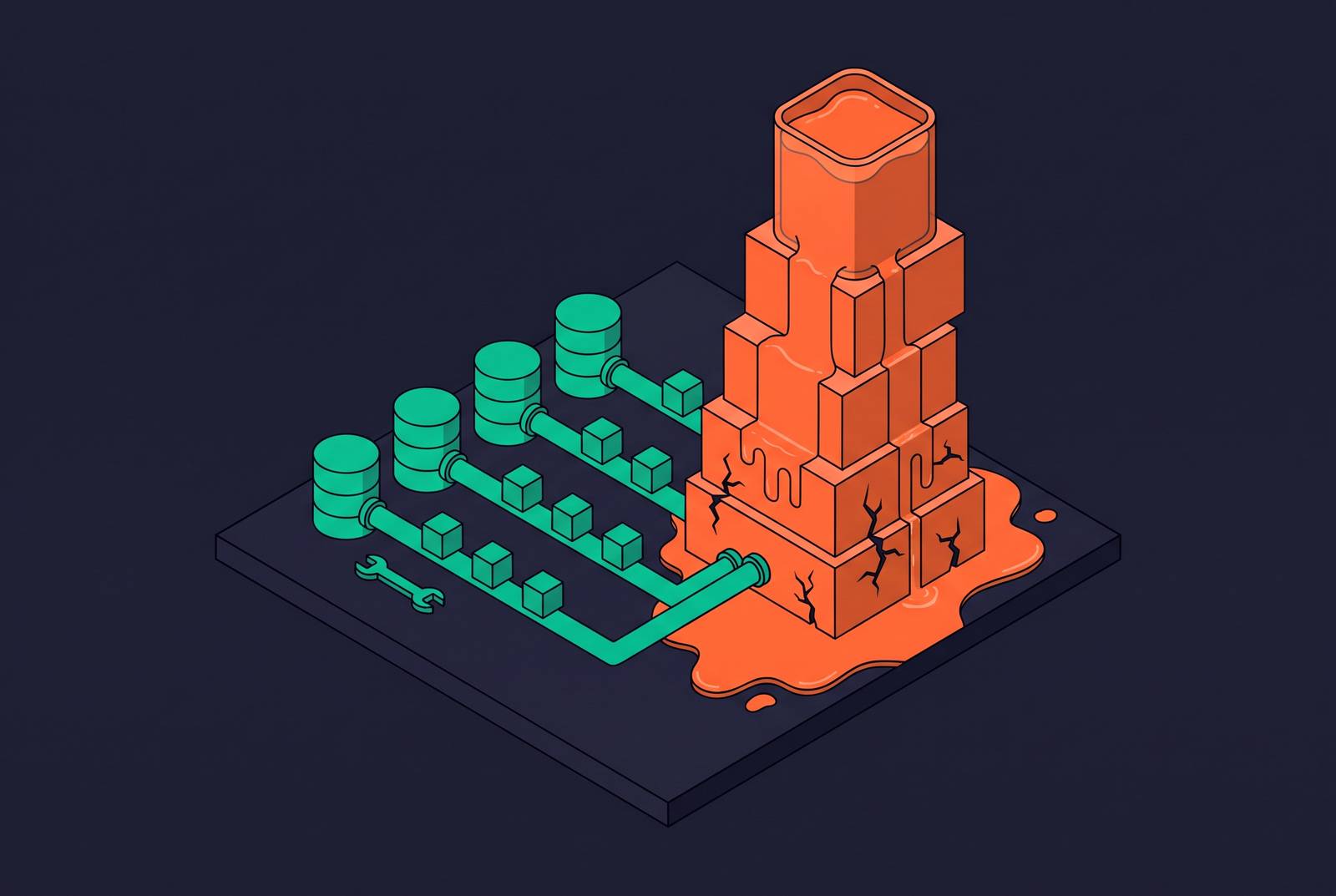
Query budget blowouts are a pricing architecture problem when every execution adds a charge, even after waste is removed. For high-volume analytical workloads, billing by provisioned compute hours avoids a separate charge for each query within that capacity. Predictable costs also require a data path that avoids egress charges on repeated reads.
Why query optimization cannot fix a bill that the pricing model already decided
An engineering team can spend a sprint optimizing queries and still get the same bill. That frustration points to a distinction between making execution cheaper and changing what the service charges for. Storage routing, the pricing model, schema layout, and egress coupling establish the cost structure before a query runs. Query rewrites, index hints, and filter pushdowns work downstream of those choices. They cannot change the contract that prices the work.
This is not an argument against efficient queries. An optimizer finds a cheaper execution path, and cutting out wasted work can bring down usage-based charges. But what happens when well-written queries still exceed the budget? At that point, another SQL audit addresses the wrong variable if the workload’s necessary scans and query volume already cost more than the budget allows. The distinction is between waste that can be removed and charges the architecture imposes on useful work.
How per-query metering structurally couples execution behavior to cost
Scan-based billing makes that distinction easy to see. In the BigQuery example, the meter counts bytes read. A query scanning a wide, unpartitioned table can cost the same whether it returns one row or a million, provided the scan is the same. The result size is not the billing event. Reading the data is.
Per-query and per-byte-scanned models are not identical, but both attach a charge to execution. One counts queries, while the other counts the data those queries scan. In either case, useful exploration and wasteful repetition can both increase the bill. The meter does not distinguish their business value. More questions therefore create a budget exposure even when each question is reasonable.
Cloud analytics billing can count bytes scanned, compute-seconds, events, seats, or capacity units. The choice of what to pay for sets which actions will cost more before an engineer writes SQL. With provisioned-capacity billing, a team instead pays for compute hours provisioned, and additional queries within that capacity have no separate marginal query charge. This changes the incentive within a finite amount of computing power.
Doesn’t scan-based billing reward efficient queries? It does, when efficiency reduces the bytes billed. But the reward stops at the minimum scan the stored data permits. The BigQuery example therefore leads back to table design.
What schema and storage layout decisions actually determine before a query runs
Partitioning strategy, clustering keys, table width, and file layout set how much data an engine has to read to meet a request. Those choices may precede the workload by months or years. In a columnar system, time partitions and clustering on frequently filtered columns can let the engine avoid irrelevant data. Without a suitable layout, a selective question may still require a broad scan.
The unpartitioned fact table illustrates the consequence. If a query asks for a limited slice of data but the layout provides no corresponding way to skip the rest, the resulting scan charge is not simply evidence of bad SQL. The missing partitioning is an upstream design decision. Rewriting the query cannot create a partition that does not exist.
File fragmentation adds another layer to the same problem. Many small files force the planner to read more manifests and scan more fragments for a logical query. Compaction of an Iceberg table addresses that layout problem. The general principle is that physical organization shapes the work billed as a scan. Query tuning can remove avoidable execution around that work, but cannot substitute for repairing the layout that requires it.
How egress coupling turns storage architecture into a compounding cost multiplier
When storage and compute sit on opposite sides of an egress billing boundary, each read adds a charge for moving the data as well as work to run the query. Even a well-written query must move the data it needs. Optimization may cut reads that are not needed, but the reads that are needed still carry a charge. That charge belongs to the data path.
Two architectures can therefore run the same query plans and have different bills. One routes reads through a billed boundary, while the other keeps those reads local to compute. As monthly reads reach tens of terabytes, movement charges can dwarf the cost of storing the data. Repeated querying magnifies the difference because the route is used again and again. The stored dataset need not grow for the movement bill to grow.
Keeping data that is queried often in memory or on NVMe close to compute means every hot-data read no longer has to go through that path. The benefit comes from locality independently of SQL quality. Cloudflare R2 provides a separate illustration through its zero-egress pricing, showing that object storage can be offered without an egress charge.
Why agentic workloads make the pricing architecture problem acute rather than theoretical
Agentic workloads amplify both execution and movement charges because they change the pattern of demand. Rather than asking one question and waiting to consider the answer, agents can probe a dataset from many angles in parallel. That fan-out multiplies billable events unless controls require agents to pause or limit themselves. A cost structure tolerable for human-paced analysis can become expensive under continuous automated exploration.
A multi-step agentic task can cost materially more than a standard chatbot exchange did a few years ago, despite falling per-token prices, because execution steps and re-sent context accumulate. Uber’s CTO reported that the annual AI budget was exhausted before the year ended as agentic tool adoption outpaced the per-seat budget model and usage-based token consumption exceeded forecasts. This illustrates the broader mismatch between a budget’s assumptions and the unit that actually gets metered.
A healthcare organization running three AI agents saw its inference costs per month grow to several times what they had been just weeks before. A retrieval fault led one agent to pull documents eight times larger than it needed. The fault was architectural, and agent volume compounded it. Connection pool exhaustion and query cost explosions can likewise show that arrival-rate assumptions no longer fit the workload, so poor query syntax alone may not explain them. Without per-agent attribution, teams also have no evidence to show how that new demand adds to the bill.
Why query governance tools treat the symptom rather than the cause
Query governors, cost estimators, and rate limiters can help cut costly work that does not need to run. An MCP gateway can set per-agent spend caps and log tool calls to track who ran what and keep runaway loops in check. Those controls constrain what gets executed. They do not change the rate charged for work that proceeds.
OpenTelemetry’s GenAI semantic conventions provide MCP-specific attributes including mcp.method.name, mcp.session.id, and gen_ai.tool.name, all in Development status. These support tracing, but do not capture cost directly. Token-count attributes used for cost estimation sit on LLM inference spans. Correlating those records can improve visibility across an observability stack. It does not turn instrumentation into a different pricing model.
If removing a governor restores the old bill, the governor is containing demand or waste within the existing cost structure. If better queries leave the bill unchanged, the next step is to check the meter before tuning the queries again. Neither observation makes governance dispensable. It establishes governance’s proper role as discipline within an architecture whose costs fit the workload.
How can compute-hour pricing avoid per-query penalties for high-volume workloads?
A pricing architecture that avoids per-query penalties needs provisioned-capacity billing, a compute data path separated from egress-generating reads, and hot data kept close to execution. These properties work together. Paying for compute hours removes the separate charge for each query within purchased capacity, but it does not by itself remove storage movement charges. Conversely, local reads do not remove a per-query meter. Predictability depends on both the billing unit and the route.
Compute-storage separation alone is therefore insufficient. It separates scaling decisions, but repeated reads can still generate movement charges if the storage path crosses a billed boundary. A cache-mesh or NVMe tier cuts that risk by keeping hot data near compute while durable data stays in object storage. A compute-hour label cannot establish where a read originates.
For agents, isolated read-only compute over shared data can pair that model with full query logging and sandboxed branches for experimentation. CHKit-style tooling also gives agents typed commands to describe, validate, test, and deploy schemas and pipelines as code. That brings schema decisions into a process where they can be validated before they establish an unnecessarily high scan floor.
For teams evaluating a managed service, the lesson is to ask both what is billed and where query reads physically originate. An answer of “from S3 on every query” calls for inspection of the route and its charges, rather than an assumption that compute-hour pricing covers everything. Additional queries can be free of a separate execution fee without being free of every cost. The capacity still has to accommodate the work.
How to audit your current architecture for pricing model risk before the next blowout
Start the audit with the billing model for every service in the stack. Identify whether each meter counts queries, bytes scanned, events, compute time, seats, or provisioned capacity, and map it to the behavior that increases the bill. Keep these distinctions explicit. A plan described as usage-based says too little to reveal whether extra questions, wider scans, or longer provisioned runtime create the exposure.
Next, trace the data path from storage to compute. Establish where reads physically originate and whether their route crosses a billed boundary, including relevant S3 paths across availability zones or to the internet. Do not infer the answer from the service’s pricing label. The purpose is to find charges attached to necessary movement that survive even when execution is efficient.
Then review schema and layout against actual production queries. At this layout checkpoint, check partitioning, clustering keys, file compaction state, and table width to find where the minimum scan reads more than those query patterns need. Follow it with the attribution checkpoint by confirming that every agent or automated pipeline is identifiable in logs, has per-agent cost attribution, and operates under a spend cap that blocks runaway loops before the billing cycle.
The order prevents an easy misdiagnosis of the bill. Fixing fragmented tables and adding spend caps can save money, while the same billing model and egress route still charge for the next rise in query volume that serves a real need. The audit searches for the places where the architecture committed the team to a cost before any query ran.