What Is Stream Processing in Real-Time Analytics Pipelines
Stream processing transforms continuous events into queryable results for real-time analytics.
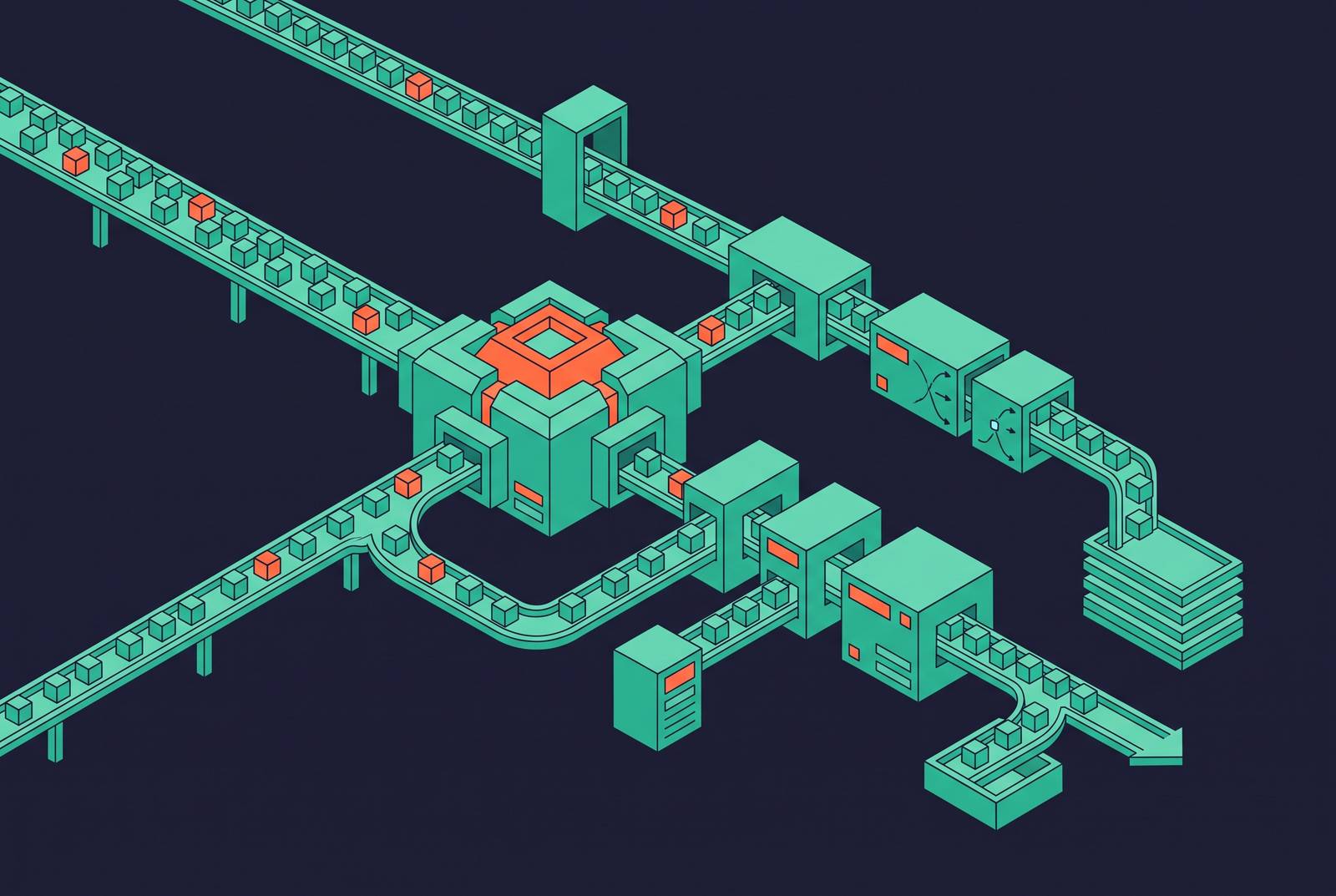
Stream processing computes results from a continuous flow of raw events so people and applications can query them. Understanding where that work sits between ingest, storage, and serving explains why a real-time pipeline is more than a batch job that runs often, and why freshness alone does not make its answers trustworthy.
What stream processing actually is and what it does to raw events
An event is raw material, such as a click, a sensor reading, or a transaction. As an individual record, it has little analytical value until it is connected to context, filtered for relevance, or counted with other events. Raw events are often unnormalized and arrive out of order. Stream processing receives this unbounded flow and continuously transforms it into structured, queryable results. The stream has no natural end, so the processor cannot wait for all the data before doing useful work.
That work includes filtering, enrichment, windowing, and aggregation. Filtering takes out records that are not relevant, while enrichment can join a click to a user profile. Windowing gives a time boundary to a calculation, allowing aggregation to produce a result such as events per minute in the last five minutes. These transformations happen continuously rather than on a schedule, which distinguishes stream processing from frequent batch execution. The larger pipeline has four stages, which are ingest, process, store, and serve.
Where stream processing sits in the ingest-process-store-serve architecture
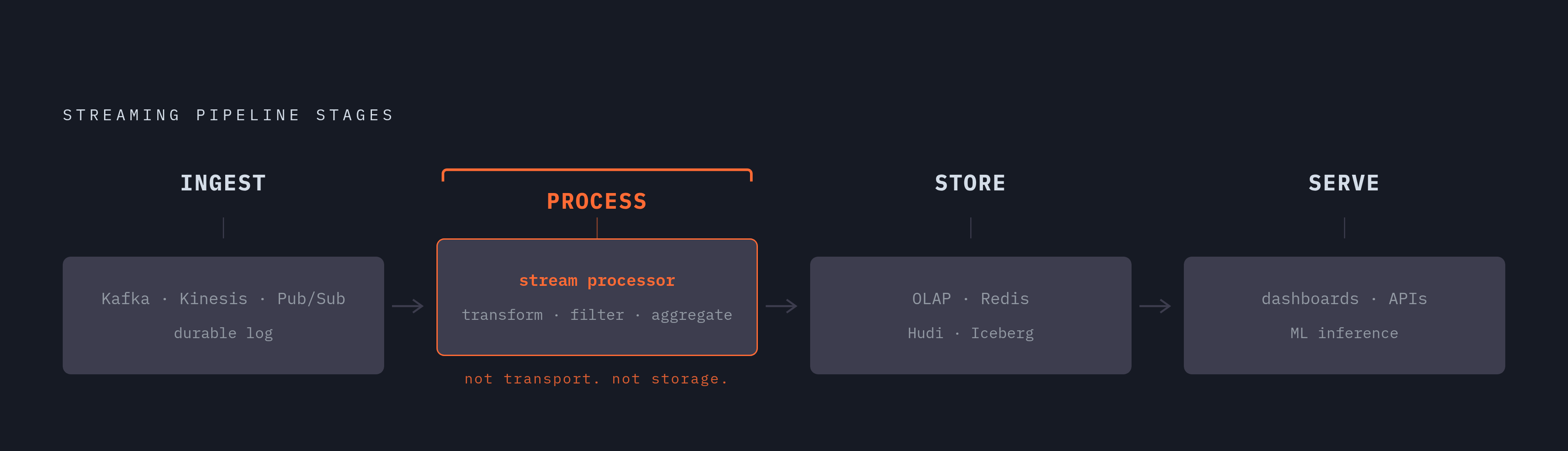
Picture four boxes with labels, linked from left to right. The ingest box captures events, the process box transforms them, the store box holds the results, and the serve box makes those results available to consumers. Stream processing occupies the second box, with a log of incoming events on one side and queryable output on the other. Other layers transport the records and provide their final query storage. Keeping these jobs separate makes it easier to see what each layer needs to do.
At ingest, sources emit events and a message broker captures and queues them. Apache Kafka, Amazon Kinesis, and Google Pub/Sub are ingestion options, while Debezium captures database changes. Durability matters because a processor can fail while new events keep coming in. Kafka stores events in an immutable, partitioned log, allowing downstream processing to resume from the last checkpoint without losing the input. The processing engine reads that log, transforms the events, and writes the results downstream.
Those results land in storage shaped around the needs of dashboards, APIs, and ML inference pipelines. In this architecture, serving consumers read the processed output. An event streaming architecture provides the distributed log and lets multiple consumers read independently, decoupling them from producers. A stream processing architecture adds stateful computation for work such as windowed aggregates and multi-stream joins. Transport makes events available, but computation makes them analytically useful.
The processing frameworks and what distinguishes them operationally
The choice between Apache Kafka Streams, Apache Flink, and Apache Spark Structured Streaming depends on what transformations need to be done. Statefulness and latency demands determine which framework can handle the required transformations. Kafka Streams is a lightweight Java library for Kafka-native processing. It handles filtering, enrichment, keyed aggregation, and stream-table joins, with RocksDB-backed state and changelog topics for recovery. Its limits matter just as much, since it reads only Kafka topics, the number of partitions limits parallelism, and complex multi-stream temporal joins push it to the edge of what it was designed to do.
Flink is a dedicated processing engine with managed state, asynchronous checkpointing, and event-time semantics. It is the heavier and more capable option for multi-source temporal joins, session windows with late-data tolerance, and complex event pattern detection through FlinkCEP. Flink also treats batch as a special case of streaming, so historical data can pass through the same logic as live events. That ability matters when old results need to be recomputed. Confluent Cloud for Flink and Amazon Managed Service for Apache Flink offer managed, usage-based options.
Spark Structured Streaming unifies batch and streaming on the same engine. Teams already running Spark for batch can use that engine for streaming too, without adding another runtime. Across these frameworks, more teams prefer SQL to define streaming transformations, which changes how they describe the work but leaves the same demands to be met. Choosing a framework also means deciding on downstream storage because the engine’s state, windows, and output structure shape what it writes. Understanding that connection starts with what the processor must remember.
What stateful processing means and why windowing is the hard part
A stateless operation handles each event independently. Filtering a record or mapping a field does not need memory of earlier input. A running total, session duration, or average does, because the answer depends on events that have already passed through the processor. Stateful processing retains and updates that information across arrivals. Its analytical power comes from that memory, but so does much of its correctness burden.
State must be kept when a failure occurs, without lost work or double-counting. A running count must pick up where it left off when its processing node disappears. Recovery mechanisms preserve a point from which computation can safely resume. Time makes the work harder because the stream itself never ends. Windowing bounds that infinite input into chunks that the engine can calculate.
A clicks per minute calculation can use tumbling windows, which are fixed intervals that do not overlap. A rolling average can use sliding windows, which overlap because they advance by less than their width. Session windows instead close after a period of inactivity, allowing the gap between events to define the session boundary. The complication is that an event may arrive after the window it belongs to, because of network delay, offline buffering, or upstream backpressure. Watermarks tell the processor when a window is complete enough to emit a result, balancing the wait for late data against the need for a fresh answer. An early answer may still be missing data and need to be corrected later, which leads to the Lambda and Kappa trade-off.
Lambda and Kappa: two answers to the freshness-versus-correctness trade-off
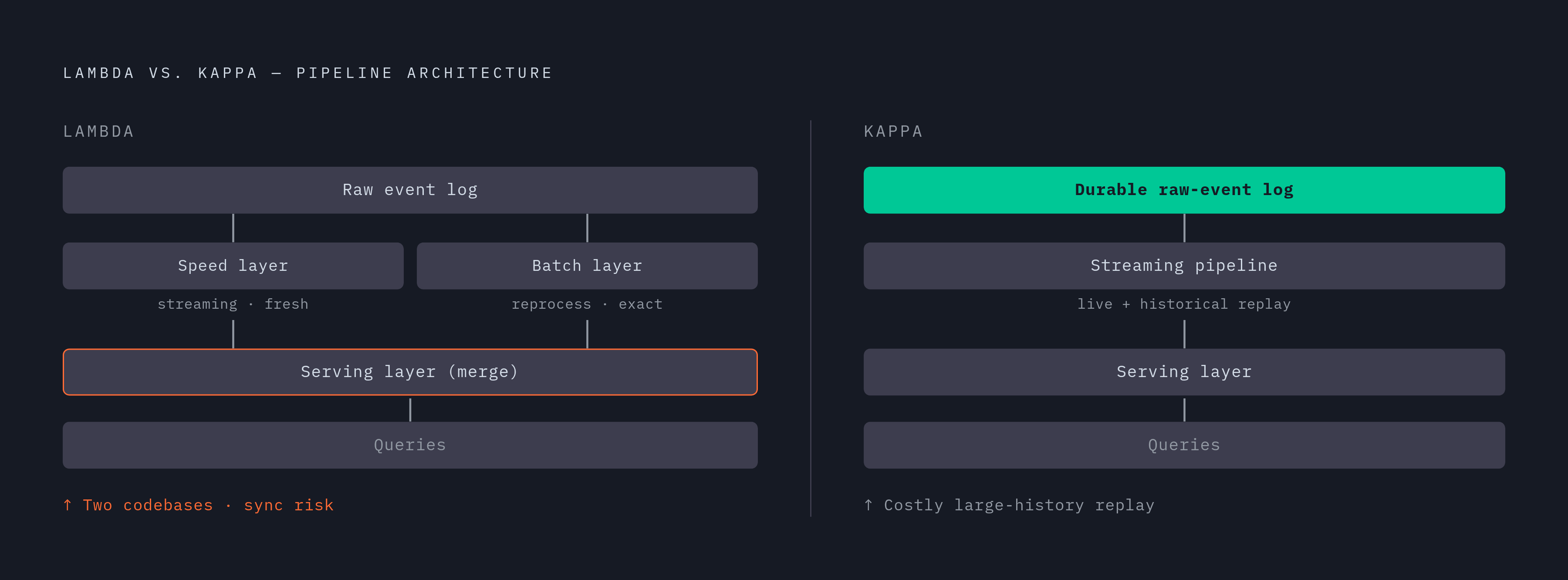
The strongest objection to streaming is that it calculates before all relevant data has arrived. Fresh results can be incomplete or approximate, and an architecture must account for that. Lambda and Kappa offer different ways to manage processing and reprocessing. With either approach, teams still have to decide how much correctness the downstream use case needs. They place the cost of meeting that demand in different parts of the system.
Lambda runs a streaming speed layer for fresh results and a batch layer that reprocesses the complete raw log for exact numbers. The serving layer merges their outputs at query time, so users get immediate numbers that are corrected as batch processing catches up. The price is two codebases expressing the same business logic. Changes must reach both paths together, and divergence between them is a source of production incidents. The more complex the transformations become, the harder that synchronization is to maintain.
Kappa drops the separate batch layer and replays a durable log of raw events through one streaming pipeline. One codebase makes the logic simpler to maintain, but the framework must process historical input efficiently. Flink’s treatment of batch as streaming fits that requirement, although replaying large histories at streaming latency can be expensive. A fraud detection system where wrong answers cost money favors Lambda’s correction mechanism, while an operational dashboard built around “approximately right, right now” favors Kappa’s simplicity. Both approaches need storage that can serve pre-aggregated streaming results at low latency.
What the storage and serving layers need from stream processing output
How quickly users can query the results is largely determined before their queries arrive. Pre-aggregation moves computation from query time to ingest time by writing summaries such as counts, sums, and distinct values per window. A dashboard can then read rows that have already been computed without scanning raw events to work out the same result again. Partitioning and the output schema further shape the work left for the query engine. The trade-off is that summaries commit to particular dimensions, so adding a new dimension may require historical reprocessing.
Storage must reflect both that output and the queries it will receive. Columnar OLAP engines read a few columns across many rows efficiently, making wide, flat, denormalized tables a common output pattern. In-memory stores such as Redis serve sub-millisecond lookups, while Apache Hudi and Apache Iceberg provide open formats for durable, streaming-friendly storage with ACID guarantees. High-concurrency reads of fresh aggregates and historical scans across months of data put different demands on storage and indexing.
Schema changes also carry operational cost when they require the pipeline to pause, the store’s DDL to change, and processing to restart before new columns become queryable. That disruption should be planned. At serve time, routing every request through cold object storage such as S3 undermines the latency gained through continuous computation. Keeping hot data in memory or solid-state storage means requests can read it without that repeated trip to cold storage. Serving performance therefore depends on where results land as well as how quickly they were calculated.
How AI agents change the query behavior a streaming pipeline must support
Human analysts usually pause between opening a dashboard, running a report, and interpreting its results. AI agents can keep probing and run queries in parallel, sending dozens of queries in seconds across different windows, dimensions, and levels of aggregation. A pipeline sized only for human dashboard traffic can be under-provisioned for that behavior. The change is not in what stream processing means, but in the volume and unpredictability of requests for its output. Fresh aggregates must remain useful under a much less restrained query pattern.
Agents can connect through direct SQL tools, text-to-SQL translation, pre-indexed retrieval, or protocol-based tool connections. Direct SQL and protocol-based tool access are especially relevant to structured, pre-aggregated output because it is already queryable. That access requires full logging of every agent query, read-only compute isolated from production writes, and row- or tenant-level controls before data reaches the model. Sandboxed compute branches let agents validate schemas, test pipelines, or explore real data without touching the production serving layer.
The economic consequence follows from the same behavior. Per-query pricing ties spending to agent activity, while compute-hour pricing decouples the bill from query count. Live model workloads also need features computed from event data and served to inference endpoints at low latency, making pipeline latency a limit on model freshness. These needs mean teams must plan together for concurrency, access control, and serving performance they can count on. The architecture that serves agents well is therefore not a separate system, but one that also serves high-concurrency human workloads at higher and less predictable query rates.
The operational properties a production streaming pipeline must guarantee
A production-grade pipeline must keep latency low under failure, preserve exactly-once behavior under retry, and make its behavior observable under load. Exactly-once processing prevents failures and retries from double-counting events in aggregates. Kafka’s transport guarantees and idempotent consumers contribute to that protection across the processing path. When a processing node fails, another must be able to resume from the last checkpoint without losing or duplicating events.
Schema governance must carry on after the first design is done. Schema registries keep producers and consumers compatible so that a change to the input does not break downstream processing without anyone knowing. Decoupling those producers and consumers through event-driven design gives the pipeline room to evolve. A new consumer can be added without changing the producer, and a processing stage can be rewritten without touching the source. That modularity keeps a change in one responsibility from requiring changes throughout the pipeline.
Finally, continuous monitoring of consumer lag, throughput, processing times, and error rates must expose slowdowns or dropped events before users encounter stale or missing results. Structured query logging completes that view by recording what was queried, when, and by whom. The same discipline makes both human and agent access auditable. A trustworthy real-time pipeline is therefore not defined by how fast it moves raw records, but by how reliably it turns them into fresh, correctable, queryable answers.